• Skip to main content
  • Skip to footer

Daniel Im

Pastor + Author

  • About
    • Contact
  • Speaking
    • Speaking Request
  • My Books
    • The Discipleship Opportunity
    • You Are What You Do
    • No Silver Bullets
    • Planting Missional Churches
  • Leadership
    • Church Multiplication
  • Life

Leadership

Campus Pastor Skill #1: How to Close a Service

August 16, 2016 By Daniel Im

Campus pastors are not highly paid emcees or volunteer coordinators as I outlined in this previous article.

Campus pastors play a critical role in the life of a multisite church. They are the vision carriers for their campus, the equipper of the equippers, the pastor of that community, and the unifying ligament to the other campuses and the broader church.

Typically, campus pastors don’t preach, unless they are also a part of the teaching team. As a result, the preaching either comes via video from the main campus, or the teaching team will prepare the sermon together and each preach it live at their respective campuses.

I’ve been a teaching pastor in both models, and they each have their respective positives and negatives. In any case, in both models, someone needs to close out the service. And my conviction is that it needs to be the campus pastor. This is one of the primary public ways that the campus pastor can shepherd their campus. Yes, obviously this will happen through leadership development environments, coffee, and ministry done together, but as a regular and ongoing rhythm, the campus pastor needs to close out the service.

As a regular and ongoing rhythm, the campus pastor needs to close out the service

Click To Tweet

I’ve seen campus pastors do this well and I’ve also seen them do it poorly. Check out this chart I developed.
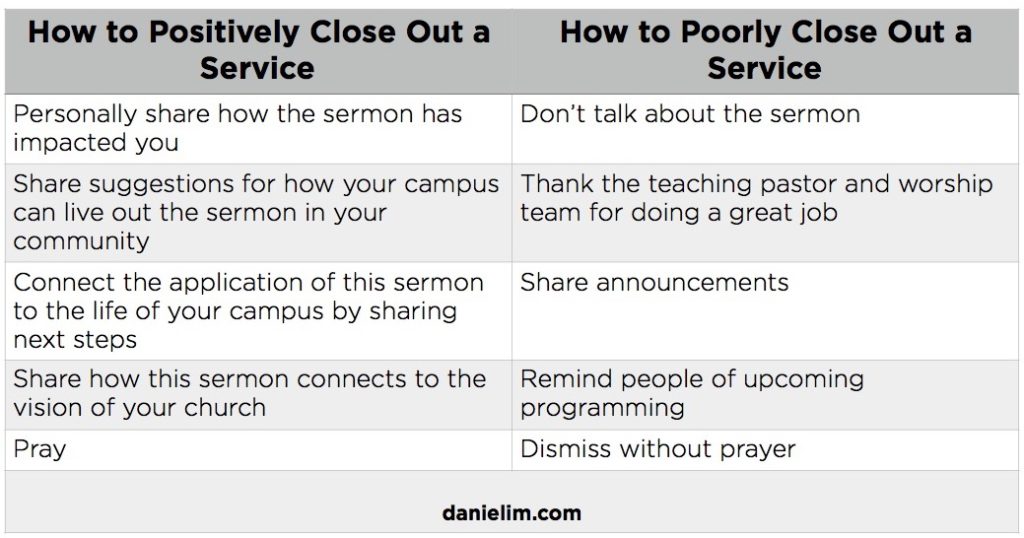
Closing out a service chart - danielim.com

This may seem pretty straightforward, but you’d be surprised at how difficult it is to stick to the positive ways to close out a service.

I know this because I’ve often done the latter when serving as a campus pastor—especially when I forgot to share an announcement earlier in the service, or needed to reemphasize a programming issue.

As a campus pastor, if you have closed out the service well by contextualizing the message to your campus, then leave any last announcement to the very end of the service, after your prayer! This is because once you finish praying, you often have the opportunity to share one more thing while people are beginning to leave. Don’t make this too long, otherwise, the positive impact of your closing will wane.

An Example…

I’m blessed to serve as a Teaching Pastor at The Fellowship, alongside two great campus pastors: Len Taylor and Scott Matthews. While being different in personality, leadership style, and demeanor, I’m so encouraged to tag team in ministry with them. There is no one perfect way to close out a service because every campus pastor needs to be true to their unique personality and leadership style. There is, however, a wrong way to close out a service—and that’s to just copy someone else and try to be someone you aren’t.

Earlier this year, I preached a message on prayer at the Two Rivers Campus of my church. Check out this video of Scott Matthews, the campus pastor, closing out this service by:

  • Shepherding the church
  • Sharing how it impacted him
  • Reiterating some important points
  • Celebrating ministry wins and creating a sense momentum
  • And offering next steps

Join me next time as I share Campus Pastor Skill #2: How to Lead Across.

Stop Getting Sidetracked by the Urgent

August 16, 2016 By Daniel Im

focus

Take a look at the agenda and minutes of one of your recent leadership team meetings:

  • What percentage of the meeting incorporates administrative or operational functions and what percentage focuses on high-level strategic issues?
  • Which items will significantly help advance mission?
  • Is there a way to delegate some or all of these operational issues to another team? If so, how? [1]

These questions, as outlined in Shelley Trebesch’s Made To Flourish: Beyond Quick Fixes to a Thriving Organization, are intended to help you diagnose a common mistake that many organizations make: allowing the urgent to overtake the strategic. 

Oftentimes, in meetings, it’s easier to brainstorm ways to solve the immediate parking issues, rather than plot out the church’s long-term strategy for city impact. Or, it’s easier to talk about ways to increase generosity and funding to meet this month’s budget, rather than thinking about how to move your church towards self-sustainability once the external funding runs out. The fact is, unless you consciously take steps to do otherwise, the urgent will always trump the strategic in your meetings.

How did we get to this place? Why is this the case?

Well, here is what typically happens in a growing church or organization. Let’s take a new church as an example. You start with the leader. As the church grows and you develop leaders to head up the different ministry departments, you begin having meetings with them. This team essentially becomes your leadership team because they are the ones in charge of getting things done in those areas. So right away, your leadership team is representative. While you might try to talk strategy in your meetings, the fact is, they weren’t recruited into their positions because they were good at strategy—you recruited them because they were responsible and knew how to get things done. Or, even better, you recruited them because they were warm bodies and had a lot of free time…okay, also because they love Jesus. No wonder the topic of your meetings always returns to logistics and operational matters—this is why they joined the team in the first place!

So how can you change the course and stop getting sidetracked by the urgent, so that you can focus on strategic issues?

[Read more…] about Stop Getting Sidetracked by the Urgent

David Isn’t a Role Model

August 9, 2016 By Daniel Im

Not everyone in the Bible is a role model. For example, who looks at Goliath and says, “I sure want to be like him when I grow up!”

However, how many times do we look up to David and try to emulate our lives after his? After all, he was the King of Israel, the greatest poet of all time, and the author of the psalms–including the famous Psalm 23, “The Lord is my shepherd, I shall not want…”

Now there are many honorable things in David’s life that we can learn from, but unfortunately, he doesn’t teach us morality. He’s the one who committed adultery, killed a man to cover up his tracks, and lied to get his way.

The fact is, David doesn’t teach us morality, he teaches us how to be human.

He teaches us how to be real and he teaches us how to have a close, intimate, and living relationship with our Lord God.

Leadership Development According to Dietrich Bonhoeffer

August 2, 2016 By Daniel Im

*My post here was originally published on July 12, 2016 in Christianity Today.

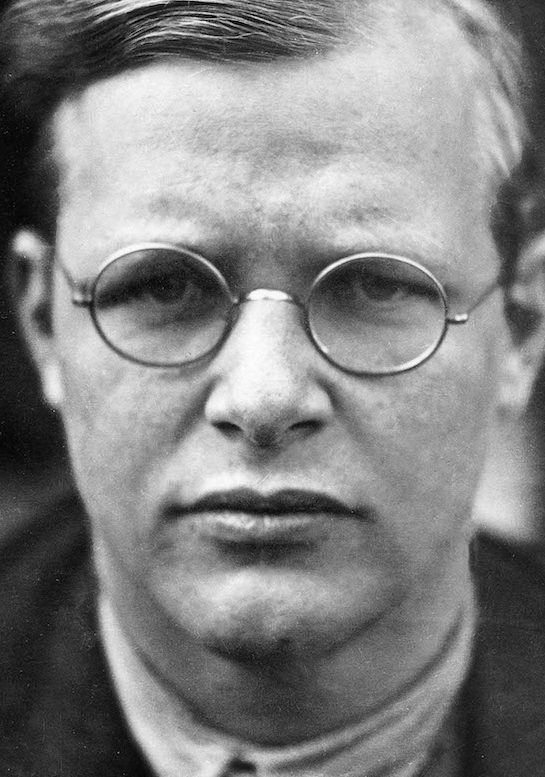
Dietrich Bonhoeffer

Does your church have an intentional development plan to disciple and deploy believers to live out the Great Commission? Are you providing strategic pathways and opportunities for your congregation to participate in church planting so that they can be a part of the Kingdom of God invading into every crevice of society both locally and globally? Or, does this happen haphazardly when someone approaches you and they say that they feel called to ministry?

Jesus said to His disciples, “The harvest is abundant, but the workers are few. Therefore, pray to the Lord of the harvest to send out workers into His harvest.” (Matthew 9:37-38 HCSB)

All Are Called

When I look at those verses, I see them as a call to pray for more harvest workers. But as a pastor and as a church leader, I also see them as a call to disciple my congregation into being harvest workers for the harvest that exists around them both locally and globally.

As a result, while a once-a-year sermon that challenges your congregation to consider full-time ministry may be helpful, it can actually create more harm than good. This sort of sermon unintentionally creates a culture that says some are called and others are not. But the reality is that all believers have the same primary calling—to go and make disciples of all nations. What we do to earn money is a secondary issue, not a primary one!

Instead of merely hoping that your preaching will stir some to see their primary vocation and calling as being harvest workers, what if you actually created intentional environments and training opportunities to call people into this reality? What if everyone in your church saw their primary vocation as being a harvest worker, where some would get a paycheck from the church if their role was to be an equipper of others (Ephesians 4:11-13), and others would get their paycheck from an employer, while serving passionately on the worship team, children’s ministry, or leading a small group? Then we would definitely see more churches get planted.

Dietrich Bonhoeffer

In Eric Metaxas’ epic biography of the pastor, martyr, prophet, and spy, Dietrich Bonhoeffer, we read about the ways that Bonhoeffer trained people for the call of ministry. Although, as the first head of the seminary in the Confessing Church, he was focusing on training individuals for full-time pastorates, there is much that we can glean from his methods that relate to our discussion at hand—training all people to embrace their first and foremost vocation as a harvest worker.

Before we get to those points, here’s a bit of background to understand why Bonhoeffer was starting a new seminary. The main reason Bonhoeffer moved back to Berlin to run the Confessing Church seminary was due to the fact that German Church seminaries had gone apostate. The German Church was compromising on theology and allowing itself to be shaped and formed by Hitler’s anti-Semitism. This was also at a time in history when the savage bloodbath known as the Night of the Long Knives had just occurred. As a result, Hitler was quickly gaining power while the divide between the German Christian Church and the Confessing Church continued to rapidly widen.

When it comes to creating intentional environments and training opportunities to encourage people to embrace their first and foremost calling as harvest workers, here are three things that we can learn from the way that Bonhoeffer designed and ran this seminary.

[Read more…] about Leadership Development According to Dietrich Bonhoeffer

Pastor, What Makes Your City Unique?

July 26, 2016 By Daniel Im

photo-1438978280647-f359d95ebda4 -1000

The type of leader who plants an urban church looks different than the one who plants a rural one.

This is a relatively unimpressive statement for obvious reasons. After all, those who would want to live on a 20 acre piece of land and raise chickens are typically not the same type of people who would want to live in an 800 square foot high rise and prune a banzai tree or a Chia pet. (Remember when that was a thing?)

This is kind of like someone who asks you if they can ask you a question, when by virtue of asking you that question, they’ve already asked you a question. Or, as the great philosopher and comedian Steve Martin said, “A day without sunshine is like, you know, night.”

What makes something obvious anyway? And who determines what constitutes as common knowledge?

Okay, before I cause you to have an existential breakdown, let me get to the point of this nonsense.

The Point

In the past few months, I’ve been traveling quite a bit talking about church planting, leadership, and discipleship. I’ve been sharing from my latest book that I co-authored with Ed Stetzer, Planting Missional Churches, as well as from the latest research we conducted on church planting and multiplication. You can download that research for free here.

As a result, I’ve had the privilege and blessing to meet with church planters and pastors in major metropolitan cities like New York, Houston, and Los Angeles. And I’ve noticed something.

The type of leader who plants a church in New York is different than the type of leader who plants in Houston or Los Angeles.

It’s not that they necessarily look different, or require distinctive theological education, but there’s definitely a difference. It’s almost…intangible.

It’s kind of like when someone asks a happily married couple how to tell if someone is the one. The answer is often, “You just know when you know.”

[Read more…] about Pastor, What Makes Your City Unique?

  • « Go to Previous Page
  • Page 1
  • Interim pages omitted …
  • Page 38
  • Page 39
  • Page 40
  • Page 41
  • Page 42
  • Interim pages omitted …
  • Page 84
  • Go to Next Page »

Footer

LET’S CONNECT

  • Facebook
  • Instagram
  • LinkedIn
  • Twitter

Copyright © 2026 · Daniel Im

  • About
  • Speaking
  • My Books
  • Leadership
  • Life