• Skip to main content
  • Skip to footer

Daniel Im

Pastor + Author

  • About
    • Contact
  • Speaking
    • Speaking Request
  • My Books
    • The Discipleship Opportunity
    • You Are What You Do
    • No Silver Bullets
    • Planting Missional Churches
  • Leadership
    • Church Multiplication
  • Life

Books

Interview with Jeff Vanderstelt on Missional Practices

January 10, 2017 By Daniel Im

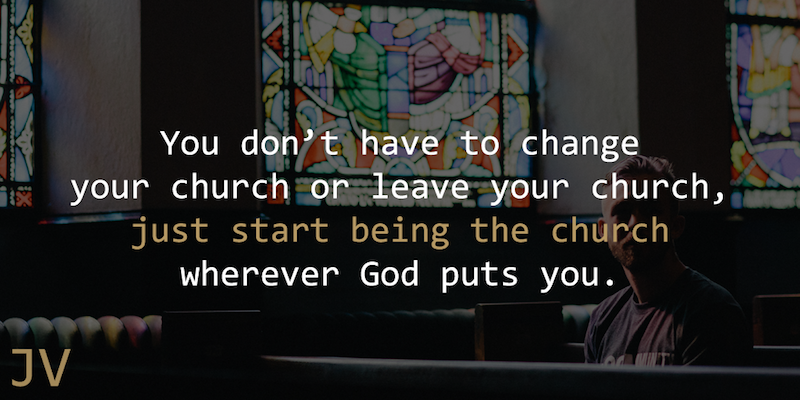
jv-church-twitter

Recently, my friend Jeff Vanderstelt shared his heart on the Saturate Field Guide that he developed with Ben Connelly, another one of my friends and one of our regular authors at NewChurches.com. Here is the interview.

Q. How can an attractional church move towards being more missional using this book?

A. The book guides believers through a study whereby they will come to understand the gospel and its implications for discipleship and mission. As participants work through the daily study and exercises, they will learn to embrace their identity as God’s family, sent as servants and missionaries to the world. The guidebook is most effective when a small group of believers commit to go through it together. As they travel together through the study, not only will they be led to personally grow as God’s missionary people, but collectively they will learn to realign their lives together around God’s purposes and mission. The guide was designed to move people from being Sunday only believers to everyday disciples who make disciples together in community while on mission.

Q. How do we normalize mission in the life of my church?

A. First of all, we need to preach the gospel indicatives – What is true about 1) who God is as revealed by 2) what God has done (especially in and through the person and work of Jesus Christ) leading to understanding 3) who we are in Christ. Then, we need to help people see how believing the gospel leads to new behaviors. The indicatives of the gospel lead to the imperatives of obedience.

The outcome of the gospel is mission

Click To Tweet

The reason this is key to normalizing mission in the church is because the church needs to understand that the outcome of the gospel is mission. God is a missionary God who sent his only son to rescue and redeem a people for his mission on the earth. God is missionary, and we are his missionary people. It begins with us understanding our true identity as God’s people. Charles Spurgeon was famous for saying: “Every Christian is either a missionary or an imposter.” There is not a category for non-missionary Christian. If you are a Christian, you are a missionary.

[Read more…] about Interview with Jeff Vanderstelt on Missional Practices

Questions to Find Your Calling

December 6, 2016 By Daniel Im

calling

“If time and money were no object, what would you do with your life?”

I forget who first asked me that question, but when they did, it was a defining moment for me. Well, it eventually became a defining moment for me. In the moment, it was just plain annoying.

I didn’t want to do the hard work of thinking. I wanted someone just to tell me what my plot in life was. I wanted someone to tell me what I was good at, so that I could just do that, and be done with it. I wanted to copy what made others successful, hoping that following their paths would do the same for me.

Boy, am I ever glad someone asked me that question. It’s what has partially catapulted me down the road to where I am today and the deep honor and privilege I have to serve pastors and church leaders.

I often return to what Sun Tzu, the Chinese general, military strategist, and author of The Art of War wrote. Let me paraphrase him,

If you know your enemy, you’ll win half of the battles. But when you know yourself, you’ll win the other half. [1]

Just imagine the implications if we spent as much time discovering the unique ways that God has wired, gifted, talented, and called us, as we do reading biographies, copying the “successful,” and mimicking models? Investing in yourself is time never wasted.

Investing in yourself is time never wasted.

Click To Tweet

The Power of the Right Questions

I love what Peter Drucker wrote about the importance of questions,

Answers are important; you need answers before you need action. But the most important thing is to ask…questions.

In order to find your calling in life, take a moment and prayerfully answer the following questions from my friend Todd Wilson’s new book, More: Find Your Personal Calling and Live Life to the Fullest Measure:

  1. Am I willing to move and go wherever God wants me to go?
  2. Am I willing to work with whomever God wants me to work?
  3. Am I willing to go whenever God asks me to go?
  4. Am I willing to do whatever God asks me to do, regardless of consequences?
  5. How can I expect God to send me and use me if I’m not really willing to go? [2]

[Read more…] about Questions to Find Your Calling

Church-Based Leadership Development

November 1, 2016 By Daniel Im

scalable-steps

A few years back, when I was in Myanmar visiting a local Bible College, I remember being in the back of a small oddly shaped “truck” bouncing around the dirt road. It didn’t feel like we were ever moving faster than 30 miles an hour. To be honest, the “truck” probably didn’t even have the capacity to do so.

As we began to drive up a hill and go around a bend, I remember our guide telling us that we were about to pass a Buddhist monastery. This monastery, he told us, had actually prevented the local electric company from extending power to the Bible College.

As I was reflecting on what it would feel like to live in a place where something like that could happen, I felt the air go thin and began to experience a bit of trouble breathing. I then felt this deep sense of heaviness in my heart. It was so vivid that I can still feel it to this day.

Eventually, a few miles later, we arrived at the Bible College to this tall wooden fence. As it opened, not only did I feel the air clear up, but the heaviness in my heart dissipated as I saw, not concrete buildings like the monastery had, but straw roofs and makeshift buildings. This felt like the most peaceful place on earth.

As I reflect on that experience—when I walked the grounds, talked to the pastors, and prayed for them—I couldn’t help but feel like my future was going to be somewhat tied to the encouraging, training, and equipping of pastors.

The harvest is plentiful, but the workers are few

When I read a particular book on missions, I couldn’t believe these three statistics that were outlined in the opening pages:

  • “In the USA there is one trained Christian worker for every 235 people. Once you leave the USA, that drops to one trained Christian worker for every 450,000 people.”
  • “An estimated 85 percent of the pastors around the world have no theological education or pastoral training.”
  • “Over 90 percent of all our tools for evangelism, discipleship, and leadership training has been produced for highly literate people.”

I know it sounds incredulous, but I believe it. Jesus said it himself, “The harvest is abundant, but the workers are few. Therefore, pray to the Lord of the harvest to send out workers into His harvest” (Matt 9:37-38).

The need is great, not just for harvest workers, but for harvest workers that are trained to have “minds for God, hearts for truth, and hands that are skilled for the task.”

What are you going to do about it?


The 6 Qualities of a Developed Leader in the Church

September 20, 2016 By Daniel Im

metrics

Growing up, my parents had some high academic standards for me. I remember the one time I got an A on my Calculus exam. It was a feeling of joy mixed with surprise because if you’ve ever done calculus, you know that it’s sometimes hard to tell if you got the question right or wrong—especially with the tricky questions.

Well, I was over the moon and I couldn’t wait to share my joy with my parents. While walking home, I was envisioning the celebration that was going to happen when I entered those doors and announced my triumph. I was victorious and the fattened calf was going to be slaughtered. We were going to party!

“Your favorite son is home! And guess what I got on my calculus exam? A big FAT A!!”

Unfortunately, the fireworks did not go off. My mom came over, took a look at the exam, and with a melancholic voice, said something to the effect of, “Oh son, good job. You should call your dad and tell him the results.”

Well, this wasn’t exactly the response I was hoping for, but maybe the celebration was going to happen when my dad heard about it. So I called him up at work and shared the good news with him. Instead of whipping out the party horn, he responded with, “So, you got 100%?”

I responded, “Well, not quite, I got 91%, but that’s still an A!”

He replied, “So…how many did you get wrong then?”

Okay. Clearly, this wasn’t going the way that I wanted it to. An A is an A. Isn’t it?

Success is an interesting thing. Unless we clearly outline metrics and define what success actually looks like, it’s up to the eye of the beholder.

This is why, for many churches, success is more about programs, than it is about people. Eric Geiger and Kevin Peck wrestle through this tension in their book, Designed to Lead: The Church and Leadership Development,

So the programmatic rat race in most churches continues. Most churches merely exist to keep running their programs and services. They are not developing leaders intentionally and consistently. When leaders emerge from some churches, it is often by accident. “Wow, a leader emerged…How did that happen?” should not be heard among God’s people. Something is missing. Something is off. (13)

As church leaders, we need to make our metrics for success the same as Jesus’. And for Jesus, “the Great Commission is Plan A,” there is no Plan B.

Geiger and Peck argue that “The Church is uniquely set apart to develop and deploy leaders for the glory of God and the advancement of the gospel.” They believe this because “leadership, apart from the work of God, cannot produce true flourishing or eternal results.”

[Read more…] about The 6 Qualities of a Developed Leader in the Church

Stop Getting Sidetracked by the Urgent

August 16, 2016 By Daniel Im

focus

Take a look at the agenda and minutes of one of your recent leadership team meetings:

  • What percentage of the meeting incorporates administrative or operational functions and what percentage focuses on high-level strategic issues?
  • Which items will significantly help advance mission?
  • Is there a way to delegate some or all of these operational issues to another team? If so, how? [1]

These questions, as outlined in Shelley Trebesch’s Made To Flourish: Beyond Quick Fixes to a Thriving Organization, are intended to help you diagnose a common mistake that many organizations make: allowing the urgent to overtake the strategic. 

Oftentimes, in meetings, it’s easier to brainstorm ways to solve the immediate parking issues, rather than plot out the church’s long-term strategy for city impact. Or, it’s easier to talk about ways to increase generosity and funding to meet this month’s budget, rather than thinking about how to move your church towards self-sustainability once the external funding runs out. The fact is, unless you consciously take steps to do otherwise, the urgent will always trump the strategic in your meetings.

How did we get to this place? Why is this the case?

Well, here is what typically happens in a growing church or organization. Let’s take a new church as an example. You start with the leader. As the church grows and you develop leaders to head up the different ministry departments, you begin having meetings with them. This team essentially becomes your leadership team because they are the ones in charge of getting things done in those areas. So right away, your leadership team is representative. While you might try to talk strategy in your meetings, the fact is, they weren’t recruited into their positions because they were good at strategy—you recruited them because they were responsible and knew how to get things done. Or, even better, you recruited them because they were warm bodies and had a lot of free time…okay, also because they love Jesus. No wonder the topic of your meetings always returns to logistics and operational matters—this is why they joined the team in the first place!

So how can you change the course and stop getting sidetracked by the urgent, so that you can focus on strategic issues?

[Read more…] about Stop Getting Sidetracked by the Urgent

  • « Go to Previous Page
  • Page 1
  • Interim pages omitted …
  • Page 5
  • Page 6
  • Page 7
  • Page 8
  • Page 9
  • Interim pages omitted …
  • Page 15
  • Go to Next Page »

Footer

LET’S CONNECT

  • Facebook
  • Instagram
  • LinkedIn
  • Twitter

Copyright © 2026 · Daniel Im

  • About
  • Speaking
  • My Books
  • Leadership
  • Life