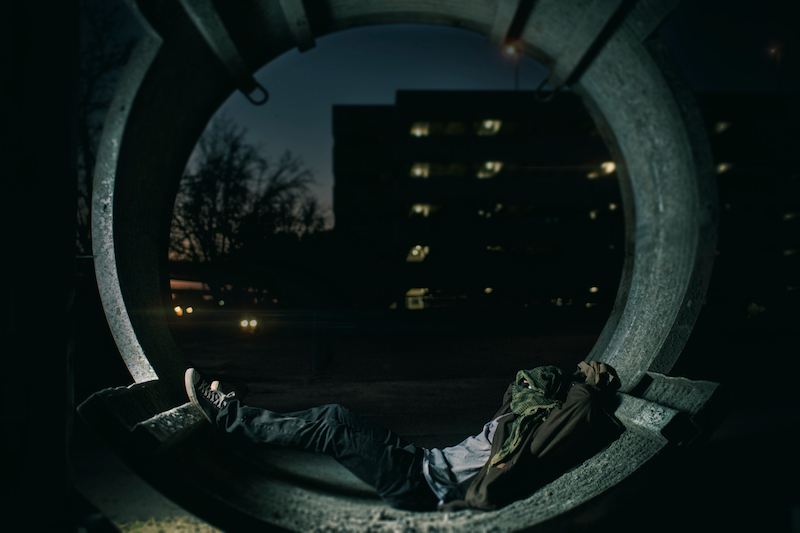
There are approximately 1 million homeless individuals in Seoul, and 300 at Seoul Station, which is a major landmark in Seoul. That’s very intriguing because the population of greater Seoul is 24.5 million people. That means 1 in every 25 people is homeless in Seoul. Since writing this article, I have had much discussion on this statistic above. I heard this initially from a worker on the field with many years of service helping out and caring for the homeless. However, in a recent article from the Yonhap News Agency in 2011, they reported that there are 4403 homeless individuals in South Korea. This number seems a bit low to me, but then again, how is the Ministry of Health and Welfare defining “homeless?” (edited on Aug 8, 2012)
Now let’s return back to my original article.
We had an outreach to the homeless in Seoul a few weeks ago, and I noticed something very intriguing about the sociology of the homeless here. We went to the City Hall Subway Station and discovered that there were three types of homeless, for lack of a better word, “lifestyles.”
The first type of “lifestyle” is the large-community “lifestyle” where many homeless individuals live together in community. For example, we saw an area at the City Hall Subway Station where 20-30 homeless individuals lived together in community. The second type of “lifestyle” is the small-community “lifestyle” where a few homeless individuals live together in community. The third type of “lifestyle” is the individualized private “lifestyle” where the homeless live by themselves.
When I noticed all three lifestyles, I wasn’t surprised by those who lived in the large-community or even small-community lifestyle because Asian Culture is so community-focused. However, what I couldn’t quite understand was why there were so many different dynamics between the lifestyles.
Here are my thoughts or hypothesis as to the differences:
1) The homeless individuals in the large-community “lifestyle” were a lot more forceful and demanding when we handed out the blankets to them. It’s almost as if they knew that they somehow deserved the charity, so they wanted as much charity as possible. As a result, I believe that the homeless who live in these larger communities have accepted their homeless condition and are more-or-less content with their identity being linked with homelessness.
2) The small-community “lifestyle” individuals are not adapting to the large-community “lifestyle” because they are possibly holding onto the hope that there is a way out of their condition. A few minutes after giving one of our blankets to the small-community “lifestyle” homeless, I saw him scratching out the bible verse that we had taped on the case. It almost seemed as if he was concerned with the “presentation” of the blanket because he wanted to sell it.
3) The homeless living a individualized private “lifestyle” actually turned out to be the most grateful for our blankets. There were even a few homeless who didn’t want the blanket and suggested that we give it to others who are more in need. Furthermore, when we gave them food, they were bowing their heads to us with gratitude – a gesture that we seldom came across with the other two “types” of homeless “lifestyles.” My hypothesis is that these homeless are F.O.S.’s – “fresh on the street.” In other words, they recently lost their job or some other unfortunate situation happened, which in turn, caused them to move to the streets. As a result, they are still living in heavy shame regarding their condition. Thus, by not associating with other homeless individuals, they are convinced that they will get back on their feet again. Homelessness is not their identity, it’s just a temporary condition.
Has anyone else seen similiar patterns of the homeless in other cities? Please correct me if I’m wrong.
The Common Locations of the Homeless in Seoul, Korea:
- Seoul Station
- Ulgiroo 3Ga Station (Line 2)
- Yeungdeongpo Goochung (Line 5) –> this station has the most homeless individuals and the majority of them will gather here at 11:00 pm to sleep.
Wonderful and very insightful observations hun!
I really enjoyed reading this. I am a new English teacher from the States. I have wanted to be involved in some form of homeless outreach here. Any ideas?
Great thanks John. Let me know what you notice in NYC 🙂
Interesting post. I’ll keep an eye on this in NYC. God bless in your ministry.
Sometimes those who stay alone have a mental illness that makes it difficult for them to be in community with others.
Hi Daniel,
Great post. I am living in Busan and researching stats on the homeless population in Seoul/Korea…curious where you got the “million” figure from? I’ve had a hard time finding numbers on this. Your source/insight would be much appreciated:)
Hi Courtney,
Thanks for your visit. I got my stats from a local Korean who runs a homeless rehabilitation centre in Korea. She is out on the streets regularly and is much more aware of the situation there.
thank you for keeping us aware of our fellow men and women in need of good thoughts, prayers and caring interventions…
Interesting post Daniel, especially how you break down the different types of lifestyles and reflect on it. I pass by Seoul Station on my way to work because I transfer there.
I did however have a possible different reading for one of your reflections. You wrote
“A few minutes after giving one of our blankets to the small-community “lifestyle” homeless, I saw him scratching out the bible verse that we had taped on the case. It almost seemed as if he was concerned with the “presentation” of the blanket because he wanted to sell it.”
I think it’s somewhat of a hasty assumption that he wanted to sell the blanket. This may be the case, but it seems not so likely to me, as a blanket could very well be more valuable to a homeless person than money because of the usefulness to survival as well as level of comfort. Another possible reason that he wanted to scratch out the bible verse might be that he is not religious, or belong to a different religion. It’s even possible that he found it offensive or that is just slightly rubbed him the wrong way. He might interpret it as taking advantage of his bad situation to try to recruit him. If he didn’t really really need the blanket or food he may have rejected outright if he was not religious. This is of course not the only possible explanation, but is a possibility. It’s just food for thought. At any rate I think it’s commendable that you were giving out blankets and food to the homeless.
I also found this study on Homelessness in S.K. from Il-Seong Yoon at Pusan National University. It might be interesting to you. Maybe you’ve already seen it.
http://econgeog.misc.hit-u.ac.jp/icgg/intl_mtgs/ISYoon.pdf
hi! i am doing a project in school about making facebook page of social entrepreneurship. This is for the homeless in Korea. There is not much information yet, but i want you to come and see our facebook page! it will be really great if you “like” our facebook page. our team will keep update our page! thx alot! 🙂
http://www.facebook.com/pages/New-Beginning/240976549291236
Interesting facts, I’ve never known this only until I saw what my mother was watching on a korean drama, and I saw homeless people in a subway station. I thought it was a joke. I live in Australia Sydney, and we don’t have homeless people in subways, but they are around business districts.
I would like to add, the homelessness rate for Australia of a population of 23 million is 100,000, and this figure counts the people that aren’t in stable accommodation, from people sleeping on friend’s couches, to people sleeping in cars, and on the streets, and homeless shelters. The reason for Australia’s so small homeless population in contrast to Australia is probably the generous social welfare and public housing that represents 4% of all housing stock, Also I like to add, that in Australia we have in Sydney alone, just 125,000 empty houses, well over the homelessness rate in Australia. And given that 23 million Australians live in around 7 million dwellings. This 125,000 is roughly 3 times the requirement for the 100,000 homeless.
I add that in USA, I have read an article a while back, that something like over 11% of homes in the US are empty. A political, economic, and social system that South Korea is in tune to.
Also I have heard in a Communist country like Cuba and North Korea, Public housing makes homelessness basically non extant strangely. And China itself an authoritarian centre-left nation has lots of public housing I heard. And Scandanavian nations of Iceland, Sweden, Norway etc, and France and Germany have very high housing stock as a well. If any kind of political change occurs, something leaning to the left wing seems feasible to really solve the housing and homelessness issue plaguing a society of community participation.
And I myself am curious what the 1 million homelessness means, it’s quite high to be true. But then 300 in a seoul subway station is a very large number.
And have you heard of the Occupy movement, of which is a neo-democracy movement that seems to put forward the issues of homelessness?
Hey Samuel,
Wow. Thanks for your thoughts! Stats are always an interesting thing, they can always be interpreted in your favour for whatever you are arguing.
What you are proposing is such an interesting insight – the fact that certain political systems, especially those on the left, are better at dealing with the issue of homelessness. Although that may be true, since they are more social, what are the issues that they are neglecting in order to fund and distribute their resources to that end? The biggest question is, do those solutions teach the homeless how to fish? Or do they just give the homeless a fish?
Where did you get the 1 million? Yonhap news reported just over 4,000 in 2011.
http://english.yonhapnews.co.kr/national/2011/09/25/0302000000AEN20110925000800320.HTML
I’m sure the numbers are not accurate, naturally, as you cannot possibly index and survey homeless people with accuracy, but 4000 to 1,000,000 is a big gap of error.
Thanks for that news article. Stats are always an interesting thing, aren’t they? I got the 1 million number from a lady who had been working with the homeless in Seoul for years and years. I’m not completely sure how she got her number.
However…I am a bit weary of the 4000 number too – it just sounds way too low for a city as big as Seoul.
People who work in the field generally tend to have this sense of martyrdom, and have the urge to make it sound as if what they’re doing is the biggest hurdle in the world, more difficult than the NASA Mars mission. I would say the real number lies far far closer to the newspaper article’s number than some lady who works in the field. End-level employees are never given accurate statistics anyway, especially when there is no accurate method of census for such people.
There are beggars on the streets of Kwangju who are not actually homeless whatsoever. They’re in a communal living situation and they are clothed and fed, albeit not very nicely. But it’s not as if they are living in the streets all the time. They are actually organized into a system so as to maximize their pan-handling income. They strategically place themselves in order to not have too much overlap, and they exchange info on which street blocks are more profitable. That’s organized living, not homelessness.
So if those people are taken out of the shady count done by some angelic social service worker, the number drops very rapidly.
Hey Jeff,
Yes, you have great points. There definitely is a sense of martyrdom for those who work in the field. My point in writing this article was more as a point of observation, rather than as a point of scholarly accuracy 🙂
Don’t get me wrong – enjoyed the article greatly. But I’m more into accurate statistics and economics and science, and proper decisions on policies are made when the numbers are more clear, so I’m quite into dissecting the actual numbers behind things, so I thought I’d do my research and inquire. I’m not one to read one article on a blog or from a friend and repeat that statistic to my friends & colleagues without verifying, hence I went on a research journey, and I learned quite a bit in that process.
Thanks for the dialogue and points Jeff. Based on our conversation, I’ll make some edits in my post 🙂
I just updated the article!
Great article Daniel. I live in Toronto and have noticed a very small homeless Asian community. It’s been so curious to me that I’ve decided to do a documentary about it. Toronto is a melting pot of EVERY culture, but the homeless community consists mostly of white and naitive Canadians. There are VERY few Asian people. There are other cultures that are less visible as well, but their population here is vast.
Toronto’s total population is 2,615,060 and there are at least 378,025 Asian people living here. On any given night there are 5,600 homeless people using shelters, only 1% of them are Asian. What are you thoughts on this? Are some culture just tighter nit as a community and take in their less fortunate or is it something else?
That is fascinating!!
However, it does not surprise me since Asians living in Canada are immigrants. Since they are immigrants, they’ve had to jump through a lot more hoops to actually get to a place where they are legally living in Canada. So they are naturally better positioned than the poor in Korea, who would never be able to immigrate.
Furthermore, immigrants tend to stick with one another, and will tend to care for one another in a deeper way, since all immigrants know what it’s like to be in a bad situation.
Thoughts?