
• Skip to main content
  • Skip to footer

Daniel Im

Pastor + Author

  • About
    • Contact
  • Speaking
    • Speaking Request
  • My Books
    • The Discipleship Opportunity
    • You Are What You Do
    • No Silver Bullets
    • Planting Missional Churches
  • Leadership
    • Church Multiplication
  • Life

Discipleship

Forgiveness, Unforgiveness, and Holding Grudges

September 25, 2025 By Daniel Im

(This is a talk that I gave to our staff at Beulah Alliance Church, elaborating on our Healthy leadership virtue)

You’ve probably heard the statement, “Unforgiveness is like drinking poison and expecting the other person to die,” right?

For most of us, unforgiveness is perceived as a black-and-white issue. You’ve either forgiven someone or you haven’t. You’ve either said, “I forgive you,” or perhaps, in not so many words, “Screw you.”

But unforgiveness is much more nuanced than saying a few words.

Consider how The Merriam-Webster Dictionary defines unforgiving,

  • “Unwilling or unable to forgive.”
  • “Having or making no allowance for error or weakness.”

And here’s how The Oxford Dictionary defines unforgiving,

  • (of a person) “Unwilling to forgive other people when they have done something wrong.”
  • (of a place, situation, etc.) “Unpleasant and causing difficulties for people.”

Those definitions are insightful because I think all of us have—at some point in our lives—said words that we really didn’t mean. Like when someone asks you, “How are you doing?” How many of you have ever said, “Fine or okay,” but you really weren’t doing fine or okay? 

I know I have.

And it wasn’t because I wanted to lie…it’s just because I really didn’t want to get into it at that point…or with that person.

Or, regarding the Florida Panthers beating the Edmonton Oilers, I wonder how many Oilers fans said the nice Canadian thing to speak to someone else, “There’s always next year!” Or, “It’s just hockey.” 

When in fact, deep down inside, you were thinking, “I HATE THE PANTHERS. Why in the world does a place like Florida have, not just one hockey team, but two?! I wish Bobrovsky would just get sick or retire!”

So in the same way, after being hurt or mistreated by someone, how many of you have ever said or thought to yourself that you had forgiven them, when in reality—if really pressed, and if you looked really deep down inside—you were actually holding a grudge against them?

“Yes, I forgive you…but I NEVER WANT TO SEE YOUR UGLY FACE AGAIN.”

“Yes, I forgive you…But YOU WILL NEVER GET ANOTHER CHANCE.”

“Yes, I forgive you…But I WILL NEVER PRAY FOR YOU AGAIN.”

Anyone?

I know I have.

But forgiving someone else isn’t just saying the words; it’s actually when your feelings toward them shift from anger to an emotion that feels more neutral. From criticism and contempt to graciously giving them the benefit of the doubt when they make a mistake. 

And as disciples of Jesus, forgiving someone else actually goes one more step. It goes from cursing to blessing.

This is why Jesus said, “But I say to you who listen: Love your enemies, do what is good to those who hate you, bless those who curse you, pray for those who mistreat you. If anyone hits you on the cheek, offer the other also. And if anyone takes away your coat, don’t hold back your shirt either.” (Luke 6:27-29 CSB)

As disciples of Jesus, we aren’t called to forgive only once, nor seven times, but seventy-seven times or seventy times seven times (Matthew 18:22).

Now the reason isn’t just so that we can be known as friendly people…or because of the importance of unity for our witness, or because unforgiveness is like drinking poison and expecting the other person to die.

No, Jesus actually gives us a deeper reason for forgiveness after he finishes teaching his disciples the Lord’s prayer, where he instructs us to pray, “forgive us our debts as we also have forgiven our debtors”:

  • “For if you forgive others their offenses, your heavenly Father will forgive you as well. But if you don’t forgive others, your Father will not forgive your offenses. (Matthew 6:14-15 CSB)

🫳🏼🎤 (that’s a mic drop emoji if you didn’t pick up on it) 😂😁

So back to being HEALTHY.

At Beulah Alliance Church, here’s how our Healthy leadership virtue is expressed: “We pray for and with one another, give each other the benefit of the doubt, and refuse to hold grudges because as spiritually, emotionally, and relationally healthy Christ followers, we are together on mission.”

Team, we can’t expect to be on mission with one another if we are still holding grudges against people we have supposedly “forgiven” with our words.

We can’t expect to be on mission together if we aren’t willing to give one another the benefit of the doubt.

And we can’t expect to be on mission together if we aren’t willing to pray for one another (Because if you’ve ever prayed for someone who hurt you, you know how hard that is).

So, today, do you have unforgiveness lurking in your heart?

  • Are there grudges that you’re holding onto that you need to release to God?
  • Is there someone that you need to start blessing instead of cursing?
  • Someone that you can pray for right now, instead of ignoring?

Let’s start our small group time together in silent prayer around those three areas. Then I’ll let you know when we can begin discussing these questions together.

Discussion Questions:

  1. Can you share a story when you’ve been on the other side? How did it feel when someone said they had forgiven you, but you still felt a cold shoulder from them? When they said that they had forgiven you, but you felt like they were still holding a grudge against you? How did you know? And then, what did you do (if anything)?
  2. As disciples of Jesus, what do you think we are called to do if we notice unforgiveness between two other people?
  3. What are some practical ways to release grudges against others?
Spiritual Formation + Relational Neuroscience

April 13, 2025 By Daniel Im

Spiritual formation, relational neuroscience, and how they intersect and interact with one another is going to be the focus of my doctoral studies for the next three years.

That’s right—12 years after graduating with my M.A. in Global Leadership—I’m starting my doctorate! I just got accepted into the Doctor of Ministry program at Western Theological Seminary. So, beginning this summer, I’ll be layering schoolwork on top of my existing and ongoing role and responsibilities as the Lead Pastor of Beulah Alliance Church. And what’s awesome is that I don’t need to relocate to Michigan to do the program. I can do it right from Edmonton.

This interdisciplinary program combining spiritual formation and brain science is the first of its kind, and I’m thrilled to dive deep into how the two areas integrate and learn from the cohort mentors, Dr. Geoff Holsclaw and Cyd Holsclaw.

But this isn’t purely an academic pursuit. Rather, the primary questions that are driving the pursuit of this doctorate for me are the following:

In this post-pandemic, post-truth, post-modern, post-Christian, and post-everything world, how can we lead our churches to effectively disciple people toward Christ-likeness? To lead our people to know Christ, be known by Christ, and to make him known?

Yes, our responsibility is primarily to sow and water seeds, while God is ultimately responsible for making them grow (1 Corinthians 3). And yes, when we sow seeds, they will all fall on different types of ground (Matthew 13), but how can we do our part even more effectively, faithfully, and fruitfully in light of the science behind attachment theory? In light of contemporary research in relational neuroscience? And in light of ancient Christian spiritual practices?

So for the next three years, I’ll be diving deep into:

  1. Attachment Theory and Theological Anthropology
  2. Ancient Spiritual Formation and Contemporary Relational Neuroscience
  3. The Connections between Theology, Therapeutic Culture, and Trauma toward the end of creating communities of care and transformation

So that’s it! That’s the announcement.

And I’m thrilled to see how everything I learn will not only integrate into our vision at Beulah to awaken Greater Edmonton to King Jesus, but to also see the people of Alberta, Canada, and the world experience genuine, lasting transformation in and through Jesus Christ.

How does the size of your gathering affect your culture of discipleship?

March 25, 2025 By Daniel Im

“What are some practical ways to shift the church culture from a monthly men’s Bible study to an accountable discipleship group? Do you start with a handful of guys and just abandon the others who only come to the monthly study, or what?”

By ordering my new book, The Discipleship Opportunity: Leading a Great-Commission Church in a Post-Everything World, Paul was able to submit this question.

So in the following video, I answer his question by unpacking how the size of your gatherings will affect your culture of discipleship.

If you would like to submit your question on discipleship, evangelism, or preaching that I’ll answer via video, check out my order offer here.

From Hearing to Doing

February 25, 2025 By Daniel Im

“How do we move our congregation from hearing to doing?”

By ordering my new book, The Discipleship Opportunity: Leading a Great-Commission Church in a Post-Everything World, Kevin F. was able to submit this question.

If you would like to submit your question on discipleship, evangelism, or preaching that I’ll answer via video, check out my order offer here.

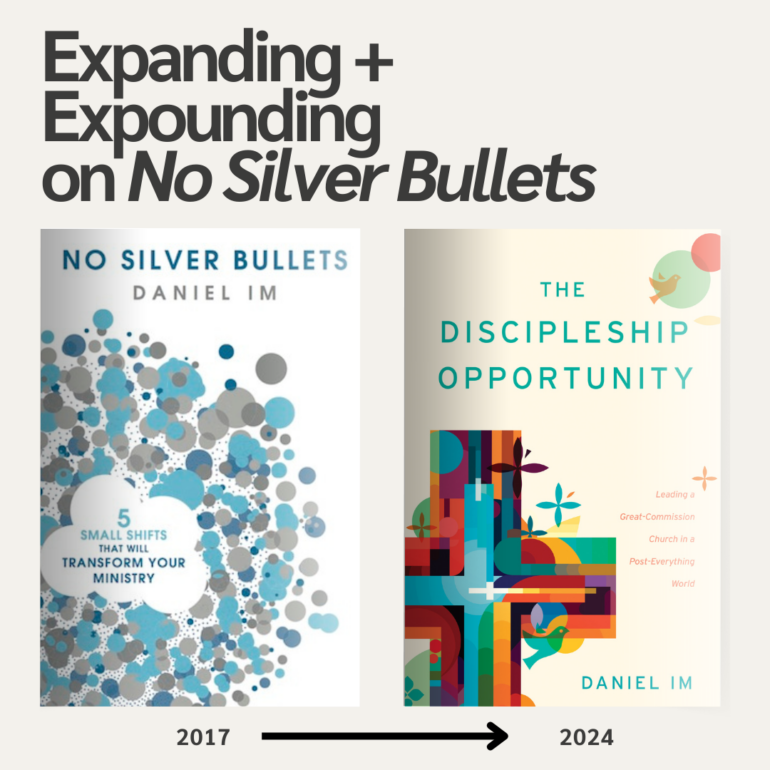
Expanding + Expounding on No Silver Bullets

February 8, 2025 By Daniel Im

Is there a 2.0 version of No Silver Bullets?

I am deeply grateful that the message of No Silver Bullets: Five Small Shifts that will Transform Your Ministry is still helping churches around the world figure out how to create a discipleship pathway, and make micro-shifts that lead to macro-changes.

But it’s been 8 years since the book released, and since then—my goodness how our world has changed!

Today, our world is arguably more divisive, more political, more indifferent, and more impatient than it’s ever been. We are living in a post-truth, post-Christian, post-pandemic, and pretty much post-everything world.

So to my question above—yes there is a 2.0 version of No Silver Bullets! It’s called The Discipleship Opportunity: Leading a Great-Commission Church in a Post-Everything World where I expand and expound on No Silver Bullets:

  • In it, I revisit the structure of a discipleship pathway that I unpacked in No Silver Bullets, and then expand and expound on how to create one in the world that we’re living in today. 
  • On top of that, I unpack the biggest shift that’s taken place over the last 70+ years of church strategy and structures in North America, and how we must adapt today. 

So if you thought No Silver Bullets was helpful, then I want to encourage you to pick up a copy of my newest book, The Discipleship Opportunity.

  • « Go to Previous Page
  • Page 1
  • Page 2
  • Page 3
  • Page 4
  • Page 5
  • Go to Next Page »

Footer

LET’S CONNECT

  • Facebook
  • Instagram
  • LinkedIn
  • Twitter

Copyright © 2026 · Daniel Im

  • About
  • Speaking
  • My Books
  • Leadership
  • Life