• Skip to main content
  • Skip to footer

Daniel Im

Pastor + Author

  • About
    • Contact
  • Speaking
    • Speaking Request
  • My Books
    • The Discipleship Opportunity
    • You Are What You Do
    • No Silver Bullets
    • Planting Missional Churches
  • Leadership
    • Church Multiplication
  • Life

Daniel Im

understanding our culture

July 18, 2008 By Daniel Im

I just read a great post from murphy24p about the relationship between culture and church.

He had these four categories “un-churched,” “de-churched,” “over-churched,” and the “churched.” As I was reading this post, I noticed that the centre point of his discussion was how individuals related to the church. Then I wondered, what would these relationships look like if we placed the cravings of the human soul as the centre point?

Here are my categories:

The Unreflective: These individuals have an understanding of the Church and Christianity that is based mostly on second-hand knowledge. In other words, their perception of the Church and Christianity is from pop culture, weddings, and funerals. Therefore, they never go to church, nor examine the claims of Christianity because they believe they already know what it’s all about.

The Hurt: These individuals have personally been hurt by Christians and/or by Churches. As a result, they see Christians and the Church as a bunch of hypocrites. They resonate with Karl Marx in believing that “religion is the opium of the masses.”

The Seeker: These individuals are more in tune with their self-identity and realize that they have these unquenchable cravings and thirsts in their life. As a result, they seek to quench these cravings in any way that they can, including through the examination of Jesus Christ.

The Sojourner: These individuals realize that life does not end when they die, but that there is eternal life through Jesus Christ. As a result, they see their time on earth as temporary and mission-oriented. There is more to life than this.

changing the perception of church in Quebec (radio appearance)

July 18, 2008 By Daniel Im

I just came back from discussing, ‘Conversations with the Homeless,’ in a radio interview with Jeffrey Mackie on CKUT 90.3 FM. If you missed it, you can listen to it here. I come up a few minutes after the clip begins.

In the interview, I also mentioned the church that I am currently serving as a Youth Pastor in River’s Edge Community Church. At River’s Edge, part of our core mission is to change the perception of Church in Quebec. This isn’t some randomly chosen mission statement, but it is uniquely tailored to our situation here in Quebec because of all the past church-related hurts and scandals that have affected and misconstrued the perception of church in Quebec.

As a result, rather than following the line of many churches today in constructing a modern facility to house our church gatherings, Lorenzo DellaForesta (our Lead Pastor) decided to go the route of obtaining and meeting in an abandoned Catholic Church. River’s Edge is not Catholic, and it is in fact the Catholic Church that many Quebecers have been hurt by. As a result, why we would we meet in a Catholic Church? Isn’t that the stupidest thing to do? Sure, maybe it would have been stupid to do it 10-15 years ago. However, considering the times we are in now, it is actually one of the most strategic things to do.

Why? Because there is an overriding sense of spirituality that pervades our post-modern culture. As a result, what many individuals crave for isn’t a modern version of Christianity, but a post-modern, spiritually-oriented community of faith that meets in a designated sacred space.

conversations with the homeless (radio appearance)

July 16, 2008 By Daniel Im

This upcoming Friday July 18th, I’ll be appearing on the radio, CKUT 90.3 FM at 8:30 am. You could also listen from the internet by clicking here.

I’ve been asked to appear on a radio show with Jeffrey Mackie to comment on an event we did a month ago with our youth ministry – Conversations with the Homeless.

We did the event for a couple of reasons.

Did you know that there are approximately 2100 verses on the poor and the oppressed in the Bible? That definitely says something in itself. Did you also know that in one of Jesus’ first sermons, he proclaimed that he was not only called to share the good news to the poor, but to also act and set them free from their oppression? (Luke 4)

As a result, I know that all of us have had contact with the homeless. My question to you is: What was your response? Did you ignore them? Did you give them something? Did you demean them? etc.

The easiest “charitable” thing to do for individuals who are homeless is to give them food, right? Well, instead of merely meeting their physical need, and feeling good about our “charitable” work, we thought we would take the next step and do something different – something that many people refuse to do and in many ways, something that is actually more difficult. We decided to give them our time. In other words, conversation.

I hope you can tune in and hear the interview.

mosquitoes, camping, and God

July 13, 2008 By Daniel Im

27 mosquito bites later, here I am sitting at my computer, trying to make sense of what has just happened.

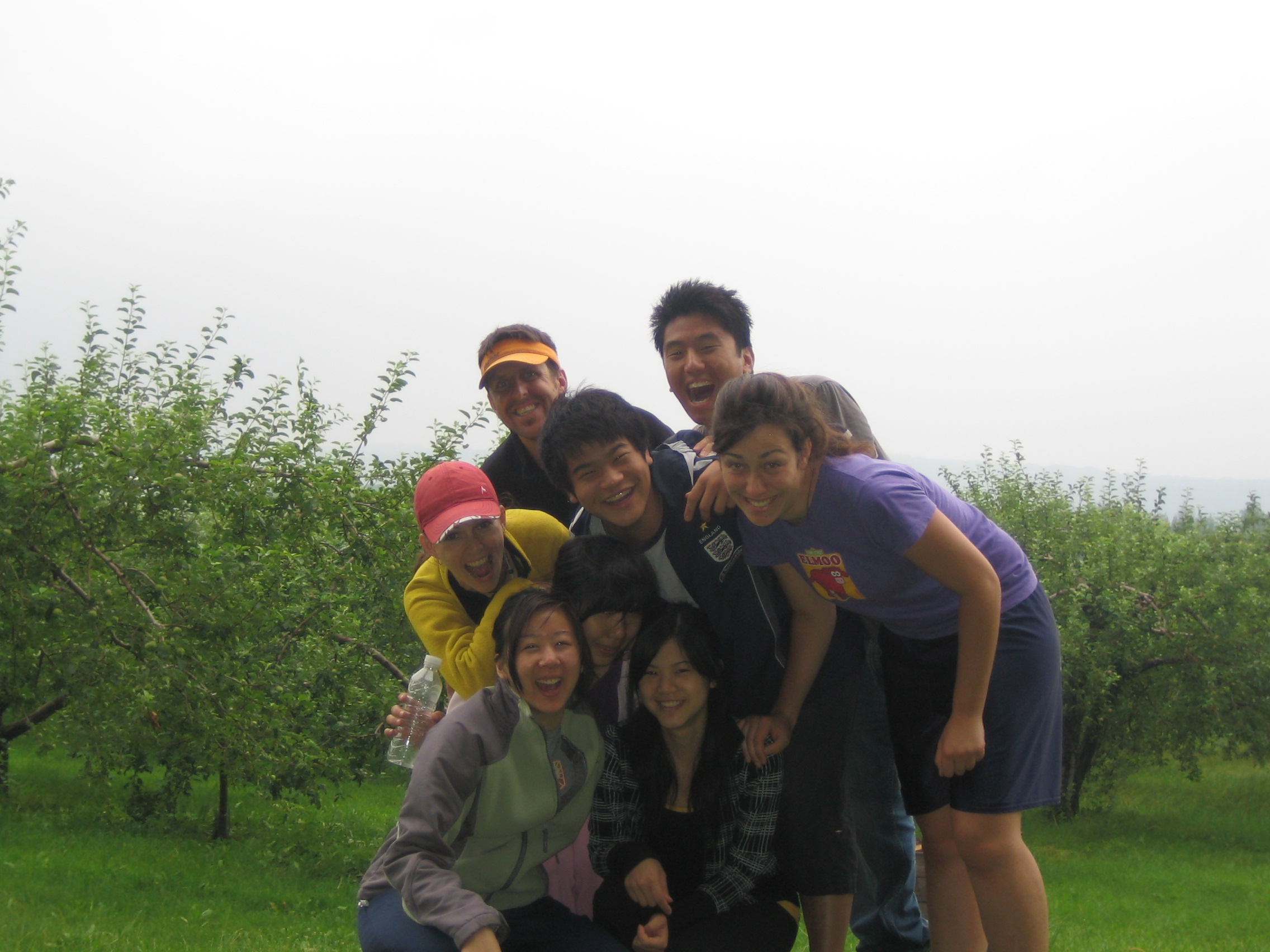
I just came back from an amazing time camping with friends from my church. It was amazing to spend the day at the beach, have bbq sausages, and just talk and talk and talk over the camp fire. It was truly a memorable time. What made the whole time even more memorable was the fact that it rained and everything in my tent got soaked. It was good though, especially since I wasn’t the only one basking in wetness :p

All that said, you are probably wondering what I am trying to make sense of. It’s one thing: Why did God create mosquitoes?

Yeah, yeah, I know the whole food chain answer, and such, but really, why did God create mosquitoes? Was it to make sure we would never enjoy summer camping? Maybe it was because he wanted to teach us how to suffer through pain? Or maybe it was so that we would realize that the world doesn’t actually revolve around us to please and serve us?

Anyway, I better reapply Afterbite – viva la mosquitoes

awakened2run camping trip

the 21st century north american church (part 3)

July 11, 2008 By Daniel Im

The New Testament and Multi-Ethnic Groups

When examining the incarnation, the apostles, the early church, and the eschatological vision in the New Testament, the ethnic picture is unambiguously multi-ethnic. This is best portrayed by looking at the very first multi-ethnic church.

The Church in Antioch as a Model for the Multi-Ethnic Church

The very first multi-ethnic church in the history of Christianity was not established by the Holy Apostles, but it was a handful of “Christians” (Acts 11:26) who, obeying Jesus’ words in the Great Commission and the Ascension, traveled to the “ends of the earth” – Antioch – to “make disciples of all nations.”

Antioch, the “religiously pluralistic and pleasure seeking” urban port city was “the provincial capital of Syria,” and “the third largest city in the Graeco-Roman empire after Rome and Alexandria.” As a result of the city’s multi-ethnic demographic, there was constant interaction between “Syrians, Romans, Greeks, Arabs, Persians, Armenians, Parthians, Cappadocians, and Jews,” which created a cultural ethos of “hatred and fear rooted in intense ethnic antagonisms.” Thus, in this global and urban port-city, the first multi-ethnic church was formed.

The church in Antioch was multi-ethnic because it was a community of faith that was composed of more than two different ethnicities, where not one ethnicity held a significant majority. For example, the leadership of the church consisted of one Jew from Jerusalem (Barnabas), another Jew from Tarsus that was also a Roman citizen (Paul), a black African (Simeon who is called Niger), a man from “the capital city of Libya in northern Africa” (Lucius of Cyrene), and the step-brother of Herod Antipas, a Roman tetrarch (Manaen).

Not only was the leadership of the church multi-ethnic, but so was the congregation. And not only was the congregation multi-ethnic, but so was the city.

Obviously, a multi-ethnic church isn’t something that can be realized everywhere, but should they not be much more evident in multi-ethnic metropolitan cities?

(Sources Cited: Ken Shigematsu, Thomas V. Brisco, Michelle Slee, Crutiss Paul DeYoung, Michael O. Emerson, George Yancey, Karen Chai Kim)

  • « Go to Previous Page
  • Page 1
  • Interim pages omitted …
  • Page 90
  • Page 91
  • Page 92
  • Page 93
  • Page 94
  • Go to Next Page »

Footer

LET’S CONNECT

  • Facebook
  • Instagram
  • LinkedIn
  • Twitter

Copyright © 2026 · Daniel Im

  • About
  • Speaking
  • My Books
  • Leadership
  • Life