• Skip to main content
  • Skip to footer

Daniel Im

Pastor + Author

  • About
    • Contact
  • Speaking
    • Speaking Request
  • My Books
    • The Discipleship Opportunity
    • You Are What You Do
    • No Silver Bullets
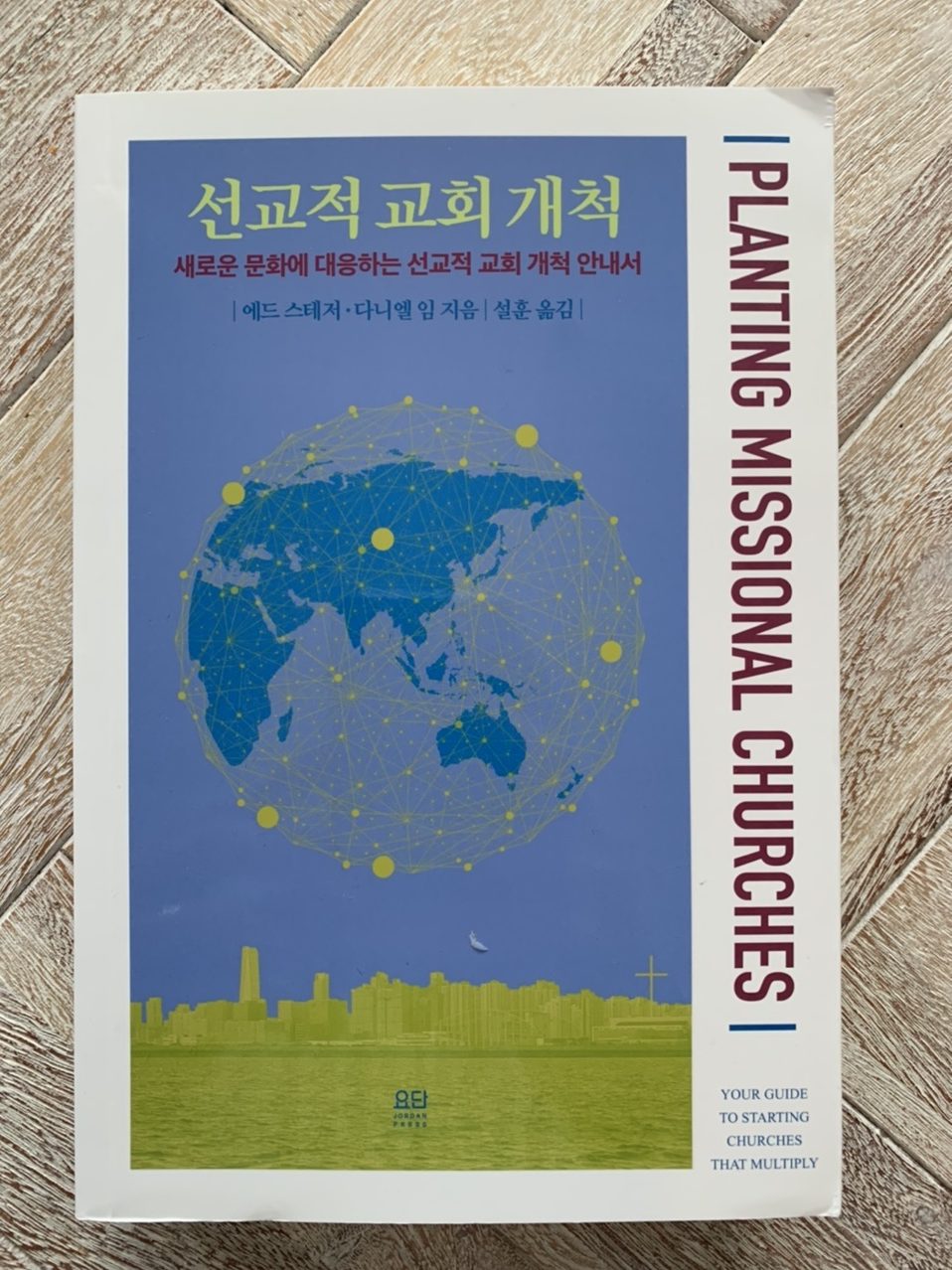
    • Planting Missional Churches
  • Leadership
    • Church Multiplication
  • Life

Daniel Im

What is Your Church’s Posture Toward Jesus?

October 7, 2021 By Daniel Im

*** If you’d like to dig deeper into the content of this article, I want to invite you to pick up a copy of my newest book, The Discipleship Opportunity: Leading a Great-Commission Church in a Post-Everything World. In this book, I unpack everything in this article in a deeper and more thorough manner. ***


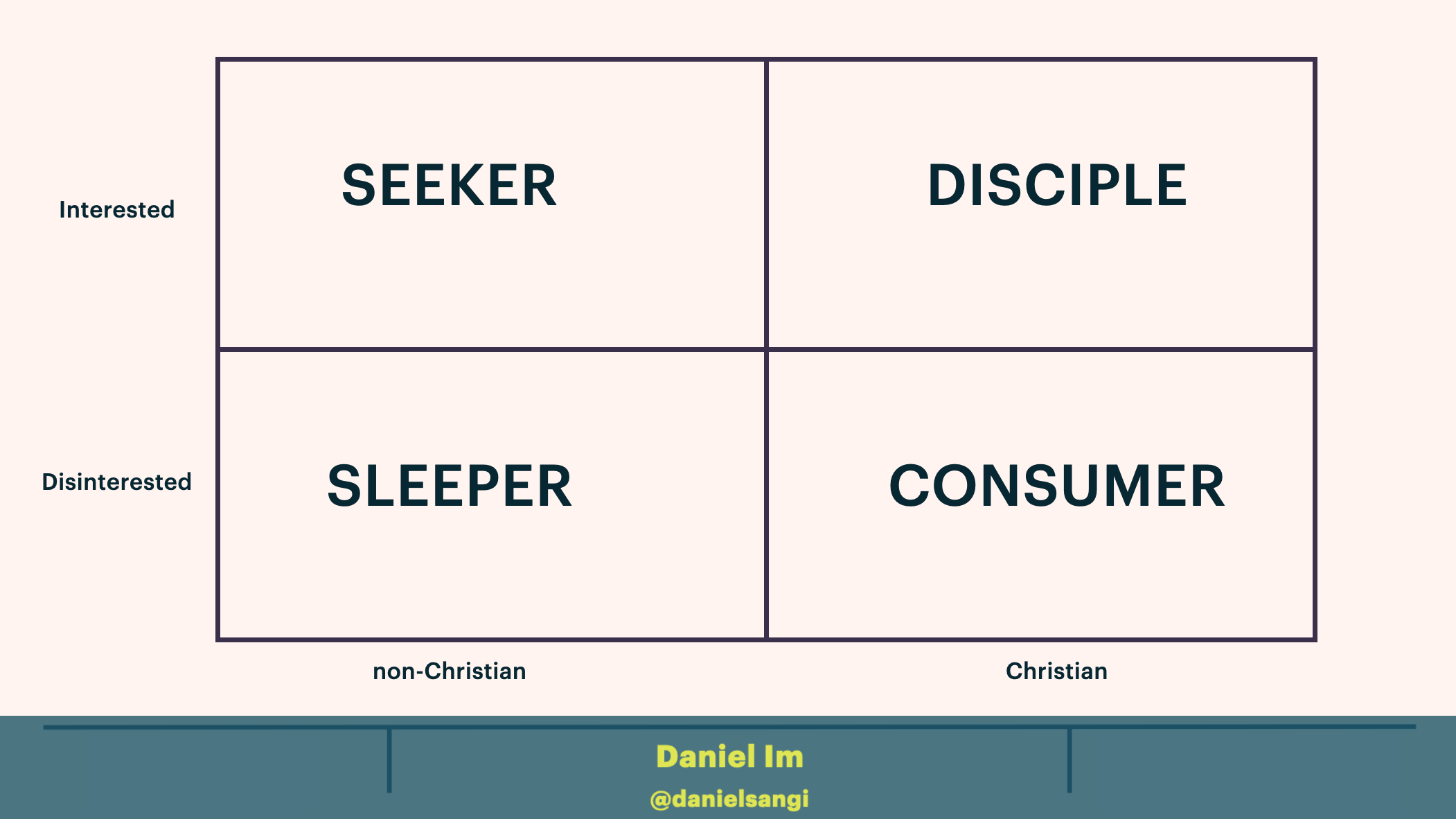
Take a look at this quadrant that I’ve been developing over this past year.

Where would you place yourself and the people in your church?

The Interested Disinterested Matrix - Daniel Im
FIGURE 1
  • SEEKERS are individuals who are interested in Jesus, but not yet Christian
  • CONSUMERS are individuals who are Christian, but not quite interested in Jesus
  • SLEEPERS are individuals who are spiritually asleep to Jesus—so they’re neither Christian nor interested in Him
  • And DISCIPLE-MAKERS are individuals who are both Christian and interested in Jesus

Do you remember the Engel Scale?

It’s a scale that represents an individual’s spiritual journey from non-Christian to Christian (see the horizontal axis in Figure 1). At the far end of the left side, you have someone who doesn’t know or understand the gospel. At the far end of the right side, you have someone who is living fully surrendered to Jesus—proclaiming the gospel in word and in deed. And the middle point is the point of salvation where an individual repents and confesses with their mouth that Jesus is Lord and believes in their heart that God raised him from the dead (Rom 10:9).

For the last few decades, one of the predominant models of ministry in the West was doing anything and everything to help people move along this line.

However, the problem with this model is that it’s linear—it assumes people are interested in Jesus. As a result, it assumes that non-Christians are interested in becoming Christian, which would make them SEEKERS. And it assumes that Christians are interested in fully living out the Great Commission to go and make disciples of all nations (Matthew 28:19), which would make them DISCIPLE-MAKERS.

But as we’ve seen over the pandemic, not everyone is actually interested in Jesus.

When churches went exclusively online, there was less and less of a reason for non-Christians to “go to church.” Especially if they weren’t actually interested in Jesus…and the only reason they went was because of some sort of external or extrinsic motivational factor, like social pressure, a parent dragging them, or because they wanted to meet someone.

Although, to some extent, this has always been happening on one level or another, we’ve seen over the past year—en-masse—what happens when a non-Christian is disinterested in Jesus, and there’s no external pressure on him or her to “go to church.” They fall asleep spiritually; in other words, they become SLEEPERS!

We’ve seen over the past year what happens when a non-Christian is disinterested in Jesus.
Click To Tweet

This is a major theme in the Scriptures—that though someone might look alive, they’re actually spiritually asleep.

“Besides this, since you know the time, it is already the hour for you to wake up from sleep, because now our salvation is nearer than when we first believed. The night is nearly over, and the day is near; so let us discard the deeds of darkness and put on the armor of light.” (Romans 13:11-12 CSB)

“Wake up, my soul!” (Psalm 57:8 CSB)

“Awake, O sleeper, rise up from the dead, and Christ will give you light.” (Eph 5:14 NLT)

In the same way, when there’s no external pressure on a Christian to “go to church,” and someone is actually in fact, disinterested in Jesus, we see that they often drift into consumption mode and become CONSUMERS.

  • e.g. “If I miss out on this week’s service, no one is going to notice…I’ll just watch later I guess…”
  • e.g. Or, “Oh wow, look I can stream the service from _______ church, _______ church, and _______ church!!!”

When there’s no external pressure on a Christian to “go to church,” and someone is actually in fact, disinterested in Jesus, we see that they often drift into consumption mode and become CONSUMERS.
Click To Tweet

So What?

Do you know that saying, “to focus on everything is to focus on nothing”? Or, “trying to do everything means you’ll eventually accomplish nothing?”

Well, I believe that’s true for ministry—especially in light of this quadrant. Trying to find a silver-bullet strategy that reaches all of these quadrants at once is like looking for the silver bullet—it’s a myth and it doesn’t exist. There are no silver bullets.

And then, to try to find a different strategy to reach each of these squares in an equal and unique way would also be ineffective, especially if you know what the 80/20 principle is.

So, in light of this quadrant and everything that’s happening in our increasingly post-Christian culture, where should our focus be?

Well, if you want to begin developing a culture of DISCIPLE-MAKERS in your church, then my recommendation is to focus on the interested, and here’s why:

  • The SLEEPERS (the disinterested non-Christians) have already left your church because why would they tune in online? And why would they wear a mask and put themselves potentially at risk by going to your service in-person? They’re asleep spiritually.
  • The CONSUMERS (the disinterested Christians) will keep on consuming whatever you put in front of them without giving back. And if they don’t like it, they’ll just change churches if they haven’t already done so! You can never satisfy consumers.

So, to begin developing a culture of disciple-makers in your church, you need to focus your preaching, programming, and plans on the interested! You need to focus on those who are SEEKING after Jesus, and those who are MAKING DISCIPLES of Jesus.

So here are a few practical ways to begin developing a culture of disciple-makers in your church through your preaching, programming, and plans:

1. Preaching

This first point is all about being aware of who you are communicating to.

In the heyday of the seeker-sensitive movement, many churches focused predominantly on non-Christians. They would put on musicals, play secular music, do large outreach events, and preach felt-need sermons to try to interest non-Christians in Jesus, in order to eventually lead them to a decision of faith.

And while their focus was predominantly on non-Christians, I don’t know of any seeker-sensitive church that did this at the exclusion of making disciples—they obviously wanted the Christians in their church to be and make disciples! As a result, many of these churches created opportunities for Christians to dive deeper on Wednesday night because the weekends were for non-Christians. And for the Christians who took advantage of opportunities like these, many of them did in fact become DISCIPLE-MAKERS.

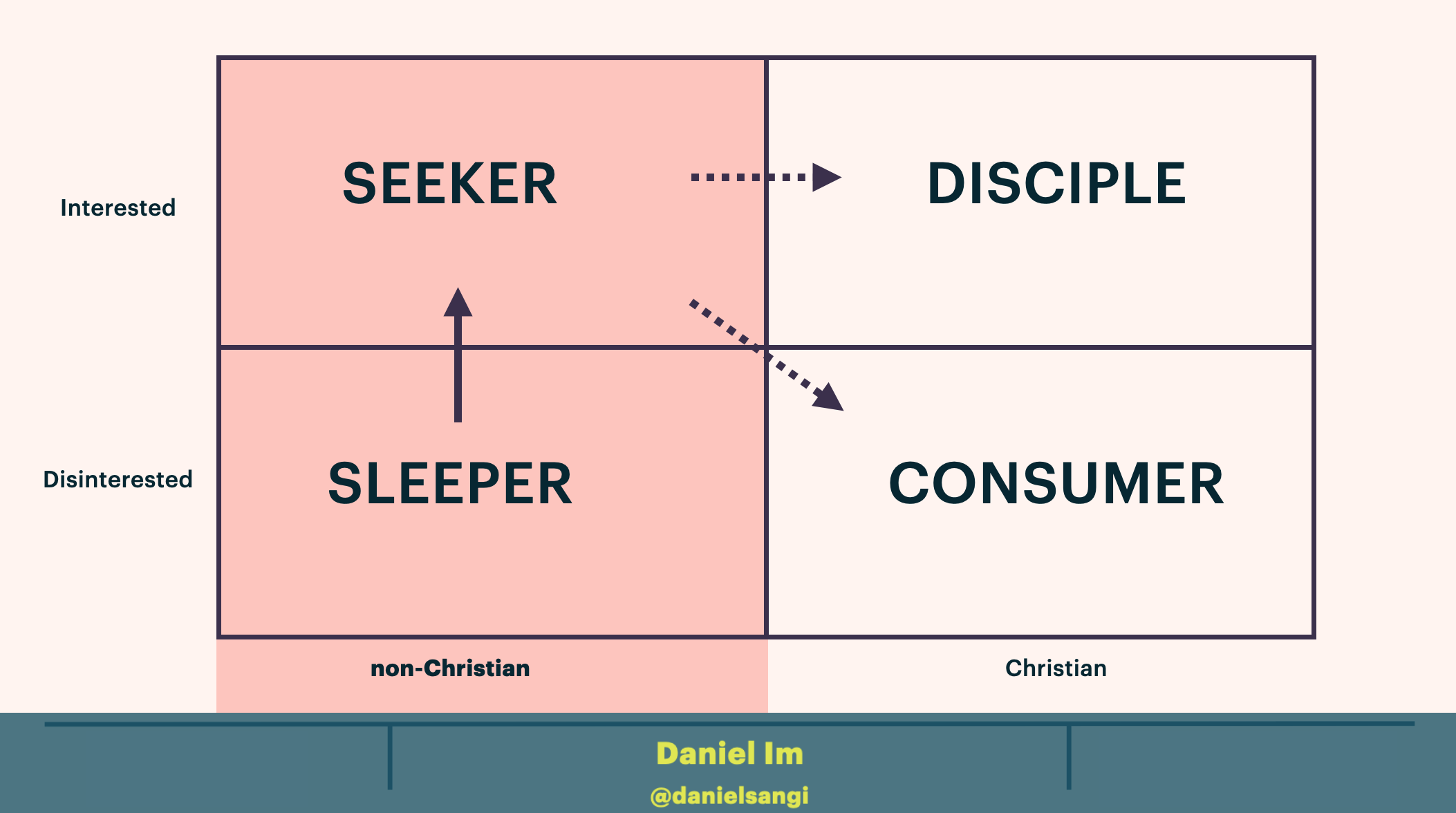
But what about the rest of the Christians who didn’t? They unintentionally drifted into becoming CONSUMERS, and then many of them subsequently either left their church for another church that would give them “meat,” or they just stayed and consumed because they were never challenged on the weekends to become a disciple-maker (See Figure 2).

The Interested Disinterested Matrix Movement - Daniel Im
FIGURE 2

Because the predominant paradigm was to focus either on non-Christians or Christians, this is what we got!

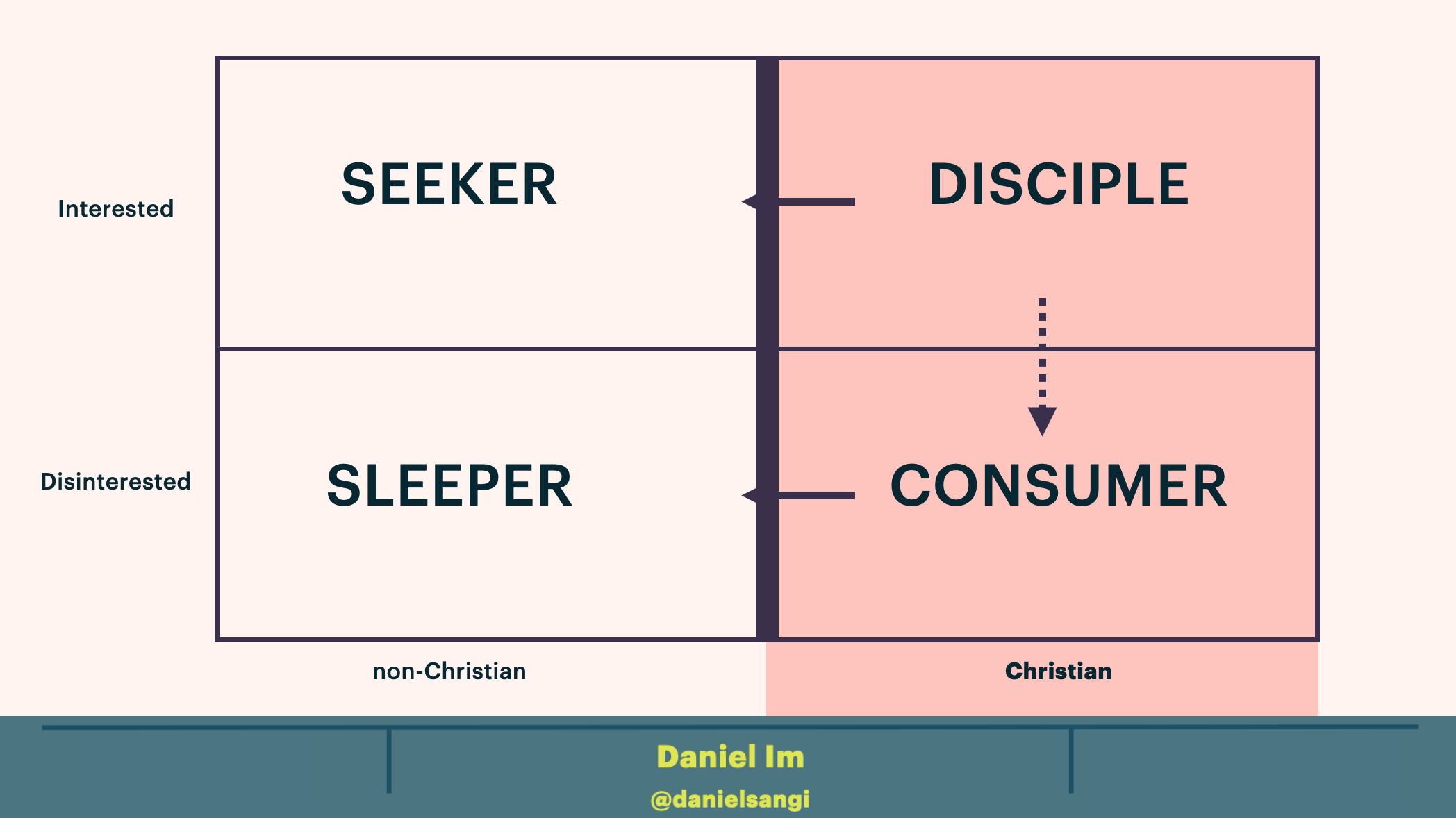
We either had seeker-sensitive churches that won many non-Christians to Christ, but ended up producing more CONSUMERS than DISCIPLE-MAKERS (see Figure 2). Or, we had churches who focused on Christians hoping to make disciples, but unintentionally ended up building a wall where evangelism was very weak or non-existent—and along the way, also ended up contributing to the problem of consumerism in the church (see Figure 3).

The Interested Disinterested Matrix Drift - Daniel Im
FIGURE 3

So what do you think your preaching would look like if you focused on the interested?

…which, in this new paradigm includes both non-Christians and Christians?

In preaching, you aren’t trying to convince the SLEEPERS to come to church with a topical series, nor are you trying to interest them in Jesus or the things of the soul (you aren’t ignoring them either). And regarding the CONSUMERS, neither are you catering to whatever they want or being content with having a low-bar to discipleship. Instead, you are preaching to those who have made the effort to come and worship together with you—to the interested who are there today.

Preach to those who have made the effort to come and worship together with you—to the interested who are there today.
Click To Tweet

So on the one hand, you’re preaching to seekers who are interested in exploring life, faith, and meaning together with others (while also inviting them to cross the line of faith). And on the other hand, you’re preaching to Christians who are interested in knowing Jesus deeply and being known by him fully (while also challenging them to not just be disciples, but to become disciple-makers).

2. Programming

So if our focus is on the interested—both the interested non-Christians and the interested Christians—how do we approach programming?

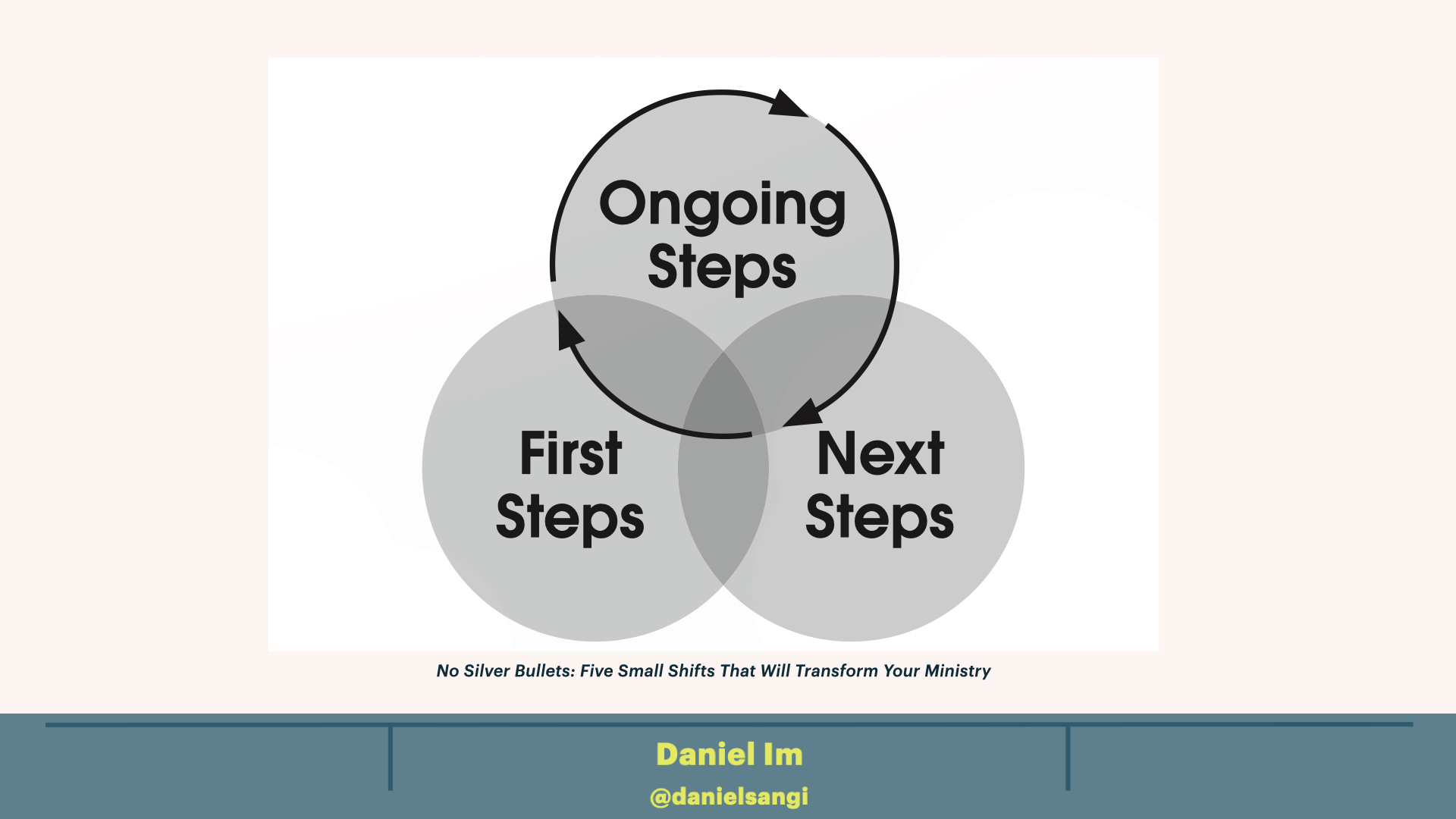
In one of my previous books, No Silver Bullets, I present this paradigm to help churches understand the components they need to develop a discipleship pathway in their church (see Figure 4).

Figure 4

First Steps are all about helping newcomers take their first step at your church. So this could include a newcomers class or your guest services process. Next Steps are short-term, temporary experiences to help people take their next step at your church (In No Silver Bullets, I articulate three different types of Next Steps: Discover, Deepen, and Deploy Next Steps). And Ongoing Steps are the practices for spiritual growth that an individual will never grow out of. Ongoing Steps are all about helping people learn how to own the responsibility for their own spiritual growth and how to feed themselves. Essentially, Ongoing Steps help individuals grow into DISCIPLE-MAKING disciples.

So, when you consider designing programming for this quadrant, there are specific steps to focus on in each square:

  • For SEEKERS, you want to focus on First and Next Steps. First steps will help you meet these individuals, so that you can help them take their Next Step to Discover who Jesus is (perhaps through a class like Alpha), or to be deployed into a service opportunity.
  • For DISCIPLE-MAKERS, you want to focus on Next and Ongoing Steps. In a Deepen Next Step, you can teach things like spiritual practices or disciple-making tools to help these individuals learn to self-feed and own the responsibility for their spiritual growth. The point of Next Steps is to then direct them toward Ongoing Steps, so that they can continually grow as disciples who make disciples.
  • For SLEEPERS, there is no formal programming. Rather, the point is to equip and empower the DISCIPLES and DISCIPLE-MAKERS in your church family to pray and to neighbour well with those they live, work, study, and play with by living out paradigms like B.L.E.S.S.. You want to help your church recognize that just like Jesus partnered with Ananias to help awaken Saul from his spiritual slumber (see Acts 9), Jesus wants to partner with you and I to help awaken the spiritually asleep to new life in Christ. Jesus is the one who does the work of awakening and heart change, but he chooses to use us (see 1 Corinthians 3).
  • For CONSUMERS, there is no formal programming to reach them either. Instead, the point is to equip and empower the DISCIPLES and DISCIPLE-MAKERS in your church family to continually be in relationship with those in and around them, be available for God to use them, and to pray for the spiritual consumers that they know. But you should never try to appease the consumers in your church because it will never be enough. Instead of lowering the bar, you need to raise the bar and focus your programming on those who are interested, not disinterested. It’s the Holy Spirit’s role to awaken the disinterested, and it’s our role to be ready to partner with the Holy Spirit when the time is right (which is why we need to stay in relationship with those who are disinterested). By the way, the tell-tale sign to identify a CONSUMER is to look for someone who is jumping from one Next Step experience to another (they don’t want to enter into Ongoing Steps because they want everything done for them).

You should never try to appease the consumers in your church because it will never be enough.
Click To Tweet

3. Plans

What does planning look like if our focus is on the interested—both the interested non-christians and the interested Christians?

Well, instead of focusing on people’s felt-needs, we need to re-learn and re-emphasize a robust Kingdom theology to be able to minister to our increasingly post-Christian culture. We need to recognize that the Kingdom of God is here, it’s growing, and it will eventually be everywhere like we read about in the parable of the mustard seed and leaven (Matthew 13:31-33).

So this means that Jesus is King—today.

And he is ruling as King over his Kingdom—today.

But today, his kingdom isn’t everywhere.

Yet his kingdom rule is continuing to grow.

And it will continue to grow until he is ruling as King everywhere!

As a result, instead of thinking that it’s our responsibility to change someone’s heart, move them across the line of faith, or guilt and shame them into a deeper relationship with Jesus, we need to trust that Jesus is King and the Great Shepherd who is watching over, and aware of all of his sheep—his found sheep and his lost ones too!

So our responsibility is to be like Ananias who was invited to partner with Jesus to awaken Saul to Himself. And we need to be like Ezekiel, who was invited to partner with God to awaken the dry bones. God is the one who awakens, so let’s focus on those whom he has already awakened—the interested (both the seekers and the disciple-makers)—and let’s be ready to partner with him to awaken the SLEEPERS and CONSUMERS when He sees fit.

God is the one who awakens, so let’s focus on those whom he has already awakened—the interested.
Click To Tweet

So let me end with this question, when you look at this quadrant, who do you want your church to be full of?

And who do you need your church to be full of, in order to be a part of seeing God’s Kingdom come and His will be done in your city as it is in heaven?

The Interested Disinterested Matrix - Daniel Im
Figure 5

*** If you’d like to dig deeper into the content of this article, I want to invite you to pick up a copy of my newest book, The Discipleship Opportunity: Leading a Great-Commission Church in a Post-Everything World. In this book, I unpack everything in this article in a deeper and more thorough manner. ***

Why Job Loss Hurts So Much

September 2, 2021 By Daniel Im

Why do we identify so much with our jobs?

Why do we even care about titles, designations, name plates, bios, and the letters after our names? And why does it hurt so deeply when all of it gets taken away?

Whether it’s your part-time job, a side gig, an in-between sort of thing, or your life’s work—it’s like a punch in the gut when you lose your job and it all gets taken away. And due to COVID-19 and the dismal unemployment rate, it’s happened to way too many people this past year.

If you’ve lost a loved one or experienced the end of a relationship, you might be familiar with the stages of grief: denial, anger, bargaining, depression, and acceptance…

…but have you ever considered that these stages might also apply to you if you’ve lost your job?

11 years ago, I remember getting a phone call from my boss. He didn’t specify why he wanted me to come to his office, nor was it even a regularly scheduled time to connect. He just told me to be there that Wednesday afternoon.

Now if it wasn’t for the Holy Spirit and all the ways that He had been nudging me that change was on the horizon, I probably would’ve died from worry while I was waiting for that meeting. Instead, I decided to turn my eyes upon Jesus, rather than my circumstances, and pray for the peace of God that transcends all understanding to guard my heart and mind in Christ Jesus (Philippians 4:7).

“I am not what I do. My identity is not my job. And though others may fail me, God I pray that you would be the strength of my heart and my portion forever.”

Even though I was earnestly praying such prayers, it still hit me like a ton of bricks when my boss told me that I was fired. I went from being a pastor at one of the largest churches in the world to a room in my parent’s house—only this time I wasn’t alone. My wife and newborn child were with me.

Over the next several days, weeks, and months, I was a wreck as I found myself walking through the stages of grief. I would go from expectant hope that God had a plan behind all of this, to the depths of depression questioning my manhood. I knew that “God causes everything to work together for the good of those who love God and are called according to his purpose” (Romans 8:28 NLT), but did I really believe that God was for me and not against me (Romans 8:31)?

I didn’t realize it at the time, but God was using these circumstances to destroy the lie that I had come to believe—that I am what I do.

This lie is fed to us from a young age. Here’s how I descrbie it in my book, You Are What You Do: And Six Other Lies about Work, Life, and Love:

As children, we’re asked what we want to do when we grow up. As adults, we’re asked what we do for work. And at the end of our lives, we’re measured by what we’ve done. It’s not surprising, then, that we believe the lie that we are what we do. It seems to be the primary way that we ascribe value and worth onto one another—and ourselves….
No wonder we over-identify ourselves with our jobs—we’ve been conditioned to do so, both from within and from without. So to satisfy both our internal craving for meaning and our external drive for a particular quality of life, we look for the perfect job. A job that boosts our self-image and also pays the bills. And if the latter is lacking, no worries— that’s why the gig economy exists. An extra gig here or side hustle there never hurt anyone, right?

As children, we’re asked what we want to do when we grow up. As adults, we’re asked what we do for work. And at the end of our lives, we’re measured by what we’ve done.
Click To Tweet

Even though everything within me was shouting, “GO AND FIND A JOB. GO AND DO,” when I finally humbled myself, laid down my hurt ego, and came to God, I sensed Him say to me, “Just be. Surrender. Trust me.”

Friends, if you find yourself in a similar circumstance, I wonder if Jesus is wanting to do the same thing in you?

I wonder if He’s wanting to use what you’re going through to break down the lie that you might’ve come to believe about work? That you are what you do? And to strip away the identity that you might’ve placed in your titles, designations, name plates, bios, and the letters after your name?

What if God is using what you’re going through to break down the lie that you’ve come to believe about work?
Click To Tweet

Instead of striving for that promotion, that dream job, or maybe just any job, what if you took the next couple of minutes, hours, or days to respond to the words of Jesus in Matthew 11:28-30 CSB?

“Come to me, all of you who are weary and burdened, and I will give you rest. Take up my yoke and learn from me, because I am lowly and humble in heart, and you will find rest for your souls. For my yoke is easy and my burden is light.”

Friends, you are not what you do. You are a child of God and that’s enough.

*My article here was originally published on April 29, 2021 on Impactus.

My Pledge as Lead Pastor of Beulah

May 20, 2021 By Daniel Im

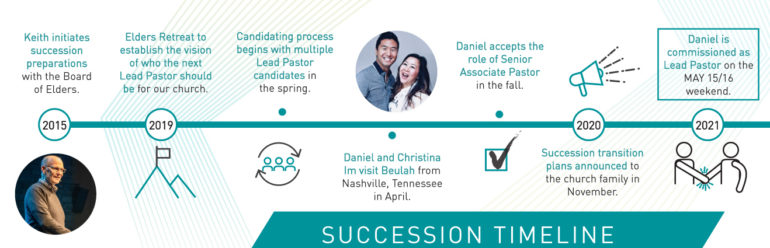
I’m humbled and honoured that this past weekend, I became the Lead Pastor of Beulah Alliance Church in Edmonton, Alberta.

If you’ve been following along with our journey, you know that for Christina and I, the journey started back in November 2018 when God began unsettling our hearts.


To learn more about the backstory of our journey back to Edmonton—and how we discerned that this was God’s calling over our lives—take a look at these two articles:

  1. The Most Important Question When Discerning Your Next Steps
  2. The Difference Between an Opportunity and a Calling

So on May 15/16, 2021, more than two and half years later, the transition officially took place as I received the baton of leadership from Pastor Keith, who has been a role model in integrity and Jesus-centred, Jesus-honouring, and Jesus-loving leadership for the past 30 years.

Here’s a highlight reel from the weekend (the full service can be viewed at the bottom of this article):

https://youtu.be/sVwxLC1UB2o

As I was preparing for the service, Brent Trask who is our regional District Superintendent for the Alliance in Canada, asked me to carefully consider making a pledge to Beulah as their new Lead Pastor. As I prayerfully considered the words he sent me, I decided to study the Scriptures and make them my own, so that I could sincerely commit myself to live by them.

In sharing my pledge to Beulah with you, I humbly ask that you would take a moment to pray these over me, but also consider what sort of commitment you are making to your church and those around you.

Here it is:

As I am strengthened by the Holy Spirit and directed by Jesus Christ who is the Head of his church, I pledge:

  • To never let the word of God depart from my mouth and to meditate on it day and night so that I may be careful to observe everything written in it
    • Joshua 1:8 CSB – “This book of instruction must not depart from your mouth; you are to meditate on it day and night so that you may carefully observe everything written in it. For then you will prosper and succeed in whatever you do.”
  • To guard my heart and give careful attention to my own hidden life with God
    • Proverbs 4:23 CSB – “Guard your heart above all else, for it is the source of life.”
  • To be a man of integrity, with no gulf between my public and private life
    • 1 John 1:6-7 CSB – “If we say, “We have fellowship with him,” and yet we walk in darkness, we are lying and are not practicing the truth. If we walk in the light as he himself is in the light, we have fellowship with one another, and the blood of Jesus his Son cleanses us from all sin.”
  • To maintain moral, doctrinal, and sexual purity
    • Matthew 5:18-19 CSB – “For truly I tell you, until heaven and earth pass away, not the smallest letter or one stroke of a letter will pass away from the law until all things are accomplished. Therefore, whoever breaks one of the least of these commands and teaches others to do the same will be called least in the kingdom of heaven. But whoever does and teaches these commands will be called great in the kingdom of heaven.”
    • 1 Timothy 4:16 CSB – “Pay close attention to your life and your teaching; persevere in these things, for in doing this you will save both yourself and your hearers.”
  • To assist in leading Beulah in an attitude of dependence upon God and his Word, trusting him to empower, fill and protect me
    • 1 Peter 5:2-4 CSB – “Shepherd God’s flock among you, not overseeing out of compulsion but willingly, as God would have you; not out of greed for money but eagerly; not lording it over those entrusted to you, but being examples to the flock. And when the chief Shepherd appears, you will receive the unfading crown of glory.”
  • To lead with the towel, not the sceptre, serving the spiritual needs of Beulah and the greater community as best I can
    • Matthew 20:28 CSB – “Just as the Son of Man did not come to be served, but to serve, and to give his life as a ransom for many.”
    • Philippians 2:7 CSB – “Instead he emptied himself by assuming the form of a servant, taking on the likeness of humanity. And when he had come as a man,”
  • To preach the word of God in season and out of season
    • 2 Timothy 4:2 CSB – “Preach the word; be ready in season and out of season; correct, rebuke, and encourage with great patience and teaching.”
  • To lead us to know Jesus deeply and be known by Him fully
    • Philippians 3:8-11 CSB – “More than that, I also consider everything to be a loss in view of the surpassing value of knowing Christ Jesus my Lord. Because of him I have suffered the loss of all things and consider them as dung, so that I may gain Christ and be found in him, not having a righteousness of my own from the law, but one that is through faith in Christ—the righteousness from God based on faith. My goal is to know him and the power of his resurrection and the fellowship of his sufferings, being conformed to his death, assuming that I will somehow reach the resurrection from among the dead.”
    • Psalm 139:23-24 CSB – “Search me, God, and know my heart; test me and know my concerns. See if there is any offensive way in me; lead me in the everlasting way.”

Thank you!

Here is the full service:

https://youtu.be/l6AW9OF3WnM

3 Habits to Build Your Marriage Upon

May 9, 2021 By Daniel Im

They say that pouring the foundation of a building is one of the most important things that you can do, so here are three habits to build your marriage upon.

These three habits—if practiced regularly—will yield the kind of results that you would’ve experienced if you had bought Amazon or Apple stock on day one.

Here they are: Give, laugh, and pray.

Give more than you take, laugh louder than you fight, and pray like your life depends upon it. When you give more than you take, you are declaring that it is more blessed to give than to receive. When you laugh louder than you fight, you are deciding not to think of yourself more highly than you ought. And when you pray like your life depends upon it, you are building your marriage upon a foundation and faith that will never let you down. Let’s dig a bit deeper into each of these habits.

Give more than you take, laugh louder than you fight, and pray like your life depends upon it.
Click To Tweet

1. Give more than you take

Let’s say you and one of your co-workers decide to go out for coffee. After putting your orders in, the barista asks if this is going to be together or separate. Since you were feeling generous, you had decided in advance that you were going to treat your co-worker to coffee. However, just as you were about to say “together,” imagine if your coworker reached into your pocket, pulled out your wallet, and replied “together” to the barista as he was tapping your credit card on the machine. How do you think that would make you feel?

Isn’t the end result the same? You were going to buy him coffee anyway, so what’s the difference? While I’m sure you don’t need me to belabor the point, there’s a stark difference in how it feels when you decide to give versus when someone takes from you.

Imagine what would happen if you approached your marriage in the same manner? Where instead of trying to make your spouse meet your needs, you instead met their needs? And where instead of focusing on ways you could get them to pay you back—or owe you one—you instead generously served them without wanting anything in return? I think this is what Jesus was referring to when he said “It is more blessed to give than to receive” (Acts 20:35 CSB).

Instead of trying to make your spouse meet your needs, what if you instead met their needs?
Click To Tweet

2. Laugh louder than you fight

A laugh-less marriage is a help-less marriage. If you find yourself grumbling, arguing, and fighting more than you are flirting, hugging, and laughing with your spouse, you’re in a dangerous place. It means you’re either taking yourself too seriously, or you’re just acting like a plain old jerk—so just stop.

A laugh-less marriage is a help-less marriage.
Click To Tweet

I love how it’s put in the Bible, “For by the grace given to me, I tell everyone among you not to think of himself more highly than he should think. Instead, think sensibly…” (Romans 12:3 CSB).

In a normal marriage, there will be times where you are going to be pulling more of the weight than your spouse. Instead of holding this against them—or thinking of yourself more highly than you should—what do you think would happen if you joyfully loved and served them instead? After all, wouldn’t you want your spouse to do the same when the reverse happens—if they haven’t already?

The next time you’re at an impasse with your spouse, stop thinking of yourself more highly than you should, and instead try smirking, tickling your spouse, and laughing. You’ll be amazed at how quickly the walls come down.

3. Pray like your life depends upon it

In Ephesians 6, we read that we are living in a spiritual world and that there is more to life than just what we see with our eyes. As a result, there is a real enemy out there whose M.O. is to steal, kill, and destroy. And he knows that one of the best ways to ruin families is by ruining marriages. So don’t let the enemy’s flaming arrows split you up, pit you against each other, or divide you. Instead, commit to praying daily with your spouse.

Commit to praying daily with your spouse.
Click To Tweet

Here’s the sticking point: While praying for one another is incredibly important and a good habit to cultivate, I’m not just referring to praying for one another, I’m talking about praying with each other. When you pray with your spouse, it’s amazing how difficult it is to hide things from them, hold a grudge against them, and also sincerely pray together. Fake, fake, fake will come out all the way through. So keep yourself honest with each other and before God by regularly praying with one another.

When you pray with your spouse, it’s amazing how difficult it is to hide things from them, hold a grudge against them, and also sincerely pray together.
Click To Tweet

So this week, I want to challenge you to give more than you take, laugh louder than you fight, and pray like your life depends upon it.

For when you give more than you take, you are declaring that it is more blessed to give than to receive.

When you laugh louder than you fight, you are deciding not to think of yourself more highly than you ought.

And when you pray like your life depends upon it, you are building your marriage upon a foundation and faith that will never let you down.

*My article here was originally published on February 4, 2021 on Impactus.

Making Sense of the Atlanta Spa Shootings (A Pastor’s Perspective)

March 24, 2021 By Daniel Im

Last week, when a self-proclaimed Christian yelled “I am going to kill all Asians” and then killed 8 people—6 of whom were Asian American women—it was too much.

Just too much.

So in this article, my hope is to help you understand:

  1. That this senseless murder was actually a racist hate crime against Asians
  2. That Jesus would never endorse or condone such hatred
  3. What we’re saying to God when we allow our churches to remain mono-ethnic

Let’s go in order.

1. This senseless murder was a racist hate crime against Asians

If you quickly Googled “Atlanta Spa Shootings,” you’ll find a lot of reporting about what happened. And the purpose of my article here isn’t to recap what happened—there’s a lot of other better places for that.

Instead, I want to point out what you may not as easily find:

  • Less than 24 hours after the shootings, a captain from the county sheriff’s office said about the killer, “Yesterday was a really bad day for him and this is what he did.” That same police officer shared a picture last year of a t-shirt that said, COVID-19 is an “imported virus from CHY-NA.” And in that post, he said “Love my shirt…get yours while they last.” [1]
  • The killer drove past hundreds of other potential “sexual temptations” for 35 miles to target three different spas owned and operated by Asian women. [2]
  • There is a long history of the fetishization of Asian women that traces itself back to wars fought in Vietnam and Korea, as well as the porn industry. [3]
  • Hate crimes against Asian-Americans in major Canadian cities are 600-700% higher than the previous year. [4]
  • Although hate crimes have risen in American cities, the majority of hate crimes never get reported, which skews the actual numbers. [5]
  • One source said “it had received more than 3,700 reports of anti-Asian verbal harassment, civil rights violations and physical assault over the last year.” [6]
  • Although the majority of anti-Asian racist attacks involved verbal harassment, physical aggression, and being coughed at and spat on, what’s troubling is how “children were more likely to be on the receiving end of physical attacks than adults. Children also reported significant mental and emotional trauma in rates that outpaced all other age groups.” [7]

If all of that wasn’t enough, here’s what threw me over the edge—an eye witness account in the media heard the killer say, “I’m going to kill all Asians” during the shooting. [8]

The only reason you haven’t heard this last point is because it was a Korean employee who was interviewed by a local Korean media source and was reporting in the Chosun Ilbo, a national Korean media outlet.

My friend, Richard Lee, who works with International Justice Mission, put it like this,

The only source saying that this was a “sexually motivated crime” is from the suspect after being interviewed by the police. If it is classified as a hate crime, the accused will have added time to his sentence. So, the same person who would suffer the most from a hate crime classification is the only source who denies it was racially motivated.

On the one hand, you have an eye witness, who was shot at and escaped with his life. But his voice is literally not being heard, because he does not speak English. Instead, we take the word of a white man, who just killed 8 people.

Why are we letting the murderer control the narrative? Why aren’t we listening to the voices of the victims? Is it because of their language and accent of their voices?

Friends, this senseless murder was a racist hate crime against Asians. Don’t let the killer and media tell you otherwise.

2. Jesus would never endorse or condone such hatred

It’s been widely reported that the killer claimed to have a sex addiction and wanted to kill these women to “eliminate temptation.” Also, he is apparently a self-proclaimed Christian who “goes to a Southern Baptist church that has been connected with Founders Ministries, now best known for its anti-Critical Race Theory efforts.” [9]

Sigh…

As Christians, although we are called to live a life of purity, and be holy because God is holy (1 Pet 1:16), heinous acts like this have nothing to do with Jesus. As I shared in this OMNI TV National Newscast, sinning by killing people to eradicate or eliminate your temptation to sin has nothing to do with Jesus and nothing to do with Christianity. (If you don’t speak Tagalog, you can skip to 3:11 to hear my response in English)

Sinning by killing people to eradicate or eliminate your temptation to sin has nothing to do with Jesus and nothing to do with Christianity.
Click To Tweet

Also, see here what it says in Proverbs 16:9 CSB, “The LORD hates six things; in fact, seven are detestable to him: arrogant eyes, a lying tongue, hands that shed innocent blood, a heart that plots wicked schemes, feet eager to run to evil, a lying witness who gives false testimony, and one who stirs up trouble among brothers.”

That is the very definition of what has just happened…and we see clearly that God is NOT on his side.

Although this killer claims to be Christian, we know in the Bible that Jesus said to beware of ravaging wolves who dress in sheep’s clothing, pretending to be Christian but who actually aren’t.

We are called to love, not hate. “We love because he first loved us. If anyone says, “I love God,” and yet hates his brother or sister, he is a liar. For the person who does not love his brother or sister whom he has seen cannot love God whom he has not seen. And we have this command from him: The one who loves God must also love his brother and sister.” (1 John 4:19-21 CSB)

We are called to love, not hate.
Click To Tweet

Friends, it’s clear that Jesus would never endorse or condone such hatred.

3. What we’re saying to God when we allow our churches to remain mono-ethnic

Seeking first “the kingdom of God and his righteousness” (Matt 6:33) has a future and present aspect to it. For the future, it’s about trusting that God will fully establish his rule and reign over all things when Jesus returns. For the present, it’s about actively praying and being a part of the growth and expansion of his rule and reign everywhere that darkness reigns.

And as we’ve experienced over this past year, one place darkness continues to reign is in the division of humanity—and the church—through racism, which is a systemic evil that’s deeply embedded in our society and culture.

Racism is a systemic evil—deeply embedded in our society and culture—that divides humanity and the church.
Click To Tweet

In the Kingdom of God, when God’s rule and reign is fully established, we know that there will be people “from every nation, tribe, people, and language, which no one could number, standing before the throne and before the Lamb” (Rev 7:9 CSB).

This doesn’t mean that race will go away or that ethnicity doesn’t matter when you become a Christian.

No, not at all! Rather, this means that God has uniquely designed every nation, tribe, people, and language to reflect a different aspect about Himself. So we need to celebrate and learn from every race and ethnic group, so that we can know and worship God deeper and more fully.

We need to celebrate and learn from every race and ethnic group, so that we can know and worship God deeper and more fully.
Click To Tweet

Now when someone who claims to be a Christian kills eight people because he was “addicted to sex” and wanted to “eliminate temptation,” we need to pay attention to what we are teaching and discipling the church about sex and temptation. And when six of the eight people are Asian American woman, and he yells “I’m going to kill all Asians” during the shootings, we need to pay attention to what we are teaching and discipling the church about the Kingdom of God.

We need to pay attention to what we are teaching and discipling the church about sex, temptation, and the Kingdom of God.
Click To Tweet

This is what happened in Atlanta last week.

We live in a society and culture that’s racist and has an imbalance of power. And the reason this seeps into the church is because of a lack of understanding about the Kingdom of God. If someone claims to be Christian and hates a particular “nation, tribe, people, or language,” they are essentially saying that they hate a part of God and want to fix God’s perfect vision for humanity. And if someone who claims to be Christian is driven more by hate than love, there needs to be an inner awakening because Scripture is clear about us being people of love, not hate.

We live in a society and culture that’s racist and has an imbalance of power. And the reason this seeps into the church is because of a lack of understanding about the Kingdom of God.
Click To Tweet

Let me quote 1 John 4:19-21 again, “We love because he first loved us. If anyone says, “I love God,” and yet hates his brother or sister, he is a liar. For the person who does not love his brother or sister whom he has seen cannot love God whom he has not seen. And we have this command from him: The one who loves God must also love his brother and sister.” (1 John 4:19-21 CSB)

Friends, please allow a vision of the Kingdom of God to shape how you talk about race, power, and the future of your church.

Come Lord Jesus come.

A vision of the Kingdom of God must shape how we talk about race, power, and the future of the church.
Click To Tweet

Footnotes:
[1] https://globalnews.ca/news/7704008/atlanta-spa-shootings-bad-day-racism/
[2] https://www.bbc.com/news/world-us-canada-56433181
[3] https://www.cnn.com/2021/03/17/us/asian-women-misogyny-spa-shootings-trnd/index.html
[4] https://www.ctvnews.ca/canada/reports-of-anti-asian-hate-crimes-are-surging-in-canada-during-the-covid-19-pandemic-1.5351481
[5] https://www.theguardian.com/us-news/2021/mar/18/fbi-pressure-anti-asian-hate-crime-atlanta
[6] https://www.washingtonpost.com/technology/2021/03/17/anti-asian-attacks-shootings/
[7] https://www.ctvnews.ca/health/coronavirus/new-report-details-disturbing-rise-in-anti-asian-hate-crimes-in-canada-1.5358955
[8] https://www.chosun.com/international/us/2021/03/17/XSDXYLMAQZCC5JWMQ4HGRZGOG4/
[9] https://www.christianitytoday.com/edstetzer/2021/march/religion-race-and-atlanta-murders-untangling-multiple-layer.html

  • « Go to Previous Page
  • Page 1
  • Interim pages omitted …
  • Page 7
  • Page 8
  • Page 9
  • Page 10
  • Page 11
  • Interim pages omitted …
  • Page 94
  • Go to Next Page »

Footer

LET’S CONNECT

  • Facebook
  • Instagram
  • LinkedIn
  • Twitter

Copyright © 2026 · Daniel Im

  • About
  • Speaking
  • My Books
  • Leadership
  • Life