• Skip to main content
  • Skip to footer

Daniel Im

Pastor + Author

  • About
    • Contact
  • Speaking
    • Speaking Request
  • My Books
    • The Discipleship Opportunity
    • You Are What You Do
    • No Silver Bullets
    • Planting Missional Churches
  • Leadership
    • Church Multiplication
  • Life

Daniel Im

Why I’m Getting Ordained

November 10, 2013 By Daniel Im

Growing up in a Korean Presbyterian church, I was always starkly aware of the difference between an ordained pastor and a non-ordained pastor. In Korean, it’s the difference between being a Moksanim and a Jundosanim. The difference is so stark that you are almost, in a sense, involved in child’s play until you become an ordained pastor.

It wasn’t until I responded to this call to ministry that I began questioning the whole matter of ordination. Why did it bother me so much that Koreans were calling me a non-ordained pastor? Why did they treat me very differently from the ordained pastors? Why would their mood and attitude towards me shift once they discovered that I wasn’t ordained?

Yes, I understand that in Acts 13 the church set apart Paul and Barnabas for the work of ministry, and then prayed for them and sent them off. And I also understand the whole concept of the priesthood in the Old Testament and their required role for the Israelites.

But what about the call in Ephesians 4 to the whole church? That “grace was given to each one of us according to the measure of Christ’s gift?” That God has given EACH OF US a calling and a measure of grace to do the work that God has set out for us?

I guess what bothered me about this ordained and non-ordained distinction was that it felt like the plain wasn’t level.

[Read more…] about Why I’m Getting Ordained

Top 10 Insights to Successfully Launch and Grow Mid-Size Communities

October 9, 2013 By Daniel Im

From my research and years of leading mid-size communities, coaching others, and forming them, here are my top 10 insights to successfully launch and grow mid-size communities:

10. Plan your gathering schedule 3-4 months out at a time.

9. Meet bi-weekly with your leadership team to have a meal where you are discipling one another, rather than a meeting where you are planning together.

8. Share resources, lessons, and email template ideas with other mid-size community leaders.

7. It’s better to delay the launch date of your mid-size community than starting it with a thin or small leadership team.

6. The gathering focus of your mid-size community (affinity, geography, or societal need) becomes your mission focus.

5. Don’t create rules to obtain behavior; instead, be a cultural architect that shapes an ethos, which leads to your desired behavior.

4. Inclusivity and smaller groups meeting in the off weeks are key factors for depth and growth.

3. Don’t let attendance become your success factor. Instead, look for vital behaviors that you can control to measure success. In other words, create a dashboard for health.

2. A clear mission focus for your mid-size community will keep it on track and ensure that it does not become a lame social gathering without purpose.

1. The health of your leadership team determines the health and longevity of the mid-size community.

What are your thoughts?

Planning a Semester Ahead (Best Practices for Mid-Size Communities)

August 23, 2013 By Daniel Im

One of the best things that you can do for your MSC is to plan a semester out.

This not only frees up your MSC lead team to allow your bi-weekly lead team meals to actually be “discipleship meals” instead of “planning meetings,” but it also allows you to strategize as to the overall direction of your MSC. This way, you can take a longer term perspective and not be constantly stressed with thinking and planning for your next gathering.

Here are the steps to planning a successful semester for your MSC:

  1. Once a semester, organize a 2-3 hour block of time for your MSC lead team to come together and plan out the focus of all the gatherings for the next 3-4 months.
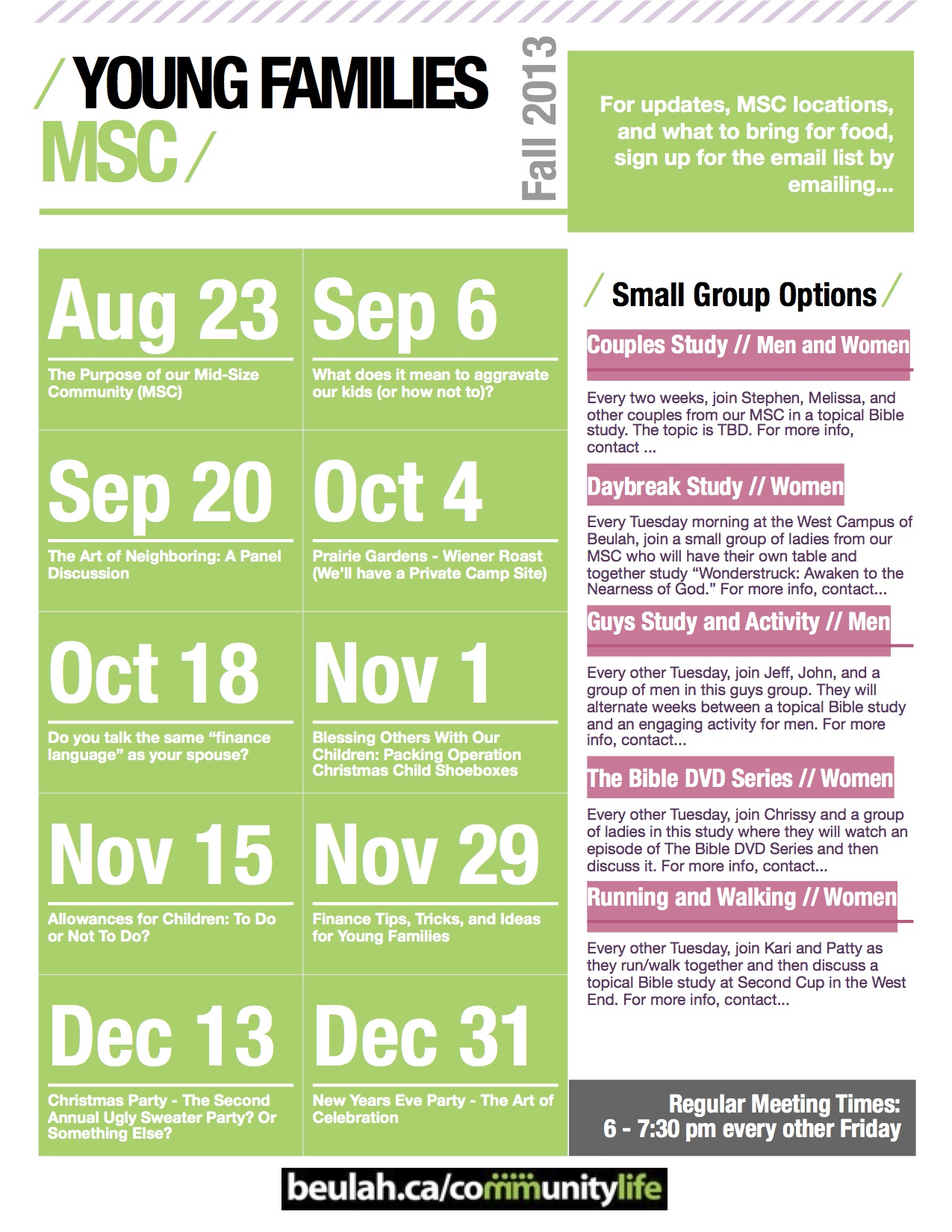
  2. Make sure that your MSC gatherings have some sort of rhythm. For example, since my MSC has a young families focus, our rotation looks like this: mission focus, marriage focus, mission focus, parent focus, mission focus, marriage focus, etc. We also do an occasional fun gathering once every 6-8 weeks (see the attached files for an idea of this).
  3. Once you brainstorm and plan out what the focus of all your gatherings are, assign a point leader for each of the gatherings. This person doesn’t have to do all the work and necessarily teach that gathering, but they are the representative on your lead team who will make sure everything will happen for that day. So they are the master coordinator of that gathering.
  4. Share the plan with your MSC using some sort of template like the one below.

Tools to Use:

  • My MSC Lead Team uses google docs as a place to write out the semester schedule and to ensure that everyone knows who owns which weeks
  • Calendar and Groups Template (PDF Version)
  • Calendar and Groups Template (Pages Version)
  • Calendar and Groups Template (Microsoft Word Version)

As you’ll see on the “Calendar and Groups Template,” I also wrote out all the different open small groups that are happening in the off weeks of my regular MSC gathering. This is to help the people in my MSC realize all the different options of small groups they can join for deeper study and community. If you don’t have small groups formed yet, or don’t have as many as I do, then please use that space as a way to envision people to form smaller groups.

Mid-Size Communities or Small Groups? Interview with Rick Howerton

May 28, 2013 By Daniel Im

Back in May 2013, I was featured on Rick Howerton’s Blog with NavPress for a four day interview on “Small Groups or Mid-Size Communities?”

Rick Howerton is one of the most genuine guys that I’ve met and I’m so grateful for his ministry to me and to the global church! Since then, he has joined the staff at Lifeway, and thus the previous posts have gone away. So I’ve taken the content that I wrote for that interview and put it up on my site in the links below:

I encourage you to read through my answers to the following questions on his site and engage in a conversation with us about this viral concept. Click on the links below to see my answers.

  • Day One – What were you trying to accomplish in your small groups that was not being achieved and why do you think the smallness of group life was keeping you from accomplishing that?
  • Day Two – When you met with your leadership team, especially your senior pastor to consider the move from small groups to mid-size groups, what questions arose (and/or what conversation took place) that drove your church to move to mid-size groups?
  • Day Three – What aspects of group life did you think you would lose by moving from small groups to mid-size groups that you found remained in tact?
  • Day Four – What does a mid-size group meeting look like and how often do these groups meet?

Let’s talk!

Mid-Size Communities Part 4: The Theological Rationale

April 18, 2013 By Daniel Im

horse

In part 3, I shared a FAQ list regarding mid-size communities (MSCs). You can get a good feeling as to what an MSC is by reading through the FAQs, or by looking at this infographic, but what’s the theological rationale for them anyway? Are MSCs just a repackaged version of Adult Bible Fellowship? Are they just the new hot thing? Or are they merely a different version of missional communities?

Well, let’s dig in. In order to look at the theological rationale for MSCs, we first need to ask more of a fundamental question: What is the church and what is her mission?

Is the Church, as Hans Kung suggests, the visible church building that people can belong to, as well as the invisible global Church composed of all true believers? Or is the Church better described, in a biblical way, as “God’s household” (Eph 2:19), “the body of Christ” (1 Cor 12:27), and a place where all of the biblical “one another’s” are lived out?

There is nothing wrong with describing the Church in those ways, but perhaps a better way to understand the Church is to begin with the end in mind? What if the Church was defined and understood through the lens of its mission? If it were, then the Church would not fall into the trap of being a loving community for its own sake or be mistaken as a rotary club. Although William Rush states that “the more the Church understands its own nature, the more it gets hold of its own vocation,” I actually believe the opposite is just as true. The more the Church understands its own mission or vocation, the more it will grab hold of its own nature.

So what is the mission that God has given the Church?

[Read more…] about Mid-Size Communities Part 4: The Theological Rationale

  • « Go to Previous Page
  • Page 1
  • Interim pages omitted …
  • Page 60
  • Page 61
  • Page 62
  • Page 63
  • Page 64
  • Interim pages omitted …
  • Page 94
  • Go to Next Page »

Footer

LET’S CONNECT

  • Facebook
  • Instagram
  • LinkedIn
  • Twitter

Copyright © 2026 · Daniel Im

  • About
  • Speaking
  • My Books
  • Leadership
  • Life